


Advantages and disadvantages in exporting Vietnamese goods to Australia
- Advantages
Australia is a potential export market for many of Vietnam's key export products such as electrical machinery/equipment, footwear, clothing and agricultural, forestry and fishery products,etc. Many of Vietnam's key export products (clothing, steel, wooden furniture...) only account for a small market share in Australia's total imports. However, Vietnam's exports of these products to Australia have tended to increase significantly in recent years, which shows that the room and potential for exporting Vietnamese goods to Australia is still very large.
In the coming time, Vietnam's exports to Australia are forecasted to continue to grow thanks to favorable factors such as:
- Under the impact of the COVID-19 pandemic, the Australian economy has also been affected following the general trend of the world, leading to a decrease in the income of most consumers. Therefore, their demand for more affordable products from developing countries like Vietnam has increased, especially essential goods such as food, clothing, etc. Meanwhile, Vietnam has the strength to produce these products at prices that are often lower than developed countries, and at the same time has the advantage of preferential tariffs from 03 common FTAs with Australia.
- The Vietnamese community in Australia is growing with the number of Vietnamese people studying and working in this country increasing in recent years. The Asian community has the same consumption trend as Vietnamese people and is also growing strongly in Australia. Therefore, the demand for consumption and use of Vietnamese products in Australia has also increased accordingly.
- Australian consumers are also more open to using imported products (including Vietnamese products) as long as the imported products meet quality requirements and have competitive prices.
- The quality of Vietnamese products is increasingly improving and gradually conquering many demanding markets. Many large Vietnamese enterprises have invested systematically and long-term in the production and export of high-standard goods to developed countries - markets with strict requirements on product quality and design. In addition, Vietnam is also focusing on attracting high-tech investment in potential industries but with outdated technology such as vegetables, fruits, seafood, etc. to improve the quality of exported products.
- Disadvantages
Besides the advantages, Vietnamese goods exported to Australia also face certain difficulties.
Firstly, the structure of Vietnam’s main export goods is not highly complementary to Australia’s import goods structure. Australia has a need to import many types of vehicles, mineral fuels, pharmaceuticals, optical equipment, etc. Meanwhile, Vietnam has strengths and exports many types of footwear, clothing, seafood, etc. Thus, many of Vietnam’s strengths are not the goods that Australia has a great demand for.
Table 1: Comparison between the top 10 products imported by Australia with the top 10 products exported by Vietnam to Australia in 2022
|
Top 10 products imported by Australia |
Top 10 products exported by Vietnam to Australia |
||
|
HS code |
Goods description |
HS code |
Goods description |
|
87 |
Vehicles other than railway or tramway rolling-stock, and parts and accessories thereof |
85 |
Electrical machinery and equipment and parts thereof; sound recorders and reproducers, television image and sound recorders and reproducers, and parts and accessories of such articles |
|
27 |
Mineral fuels, mineral oils and products of their distillation; bituminous substances; mineral waxes |
84 |
Nuclear reactors, boilers, machinery and mechanical appliances; parts thereof |
|
84 |
Nuclear reactors, boilers, machinery and mechanical appliances; parts thereof |
64 |
Footwear, gaiters and the like; parts of such articles |
|
85 |
Electrical machinery and equipment and parts thereof; sound recorders and reproducers, television image and sound recorders and reproducers, and parts and accessories of such articles |
61 |
Articles of apparel and clothing accessories knitted or crocheted |
|
30 |
Pharmaceuticals |
62 |
Articles of apparel and clothing accessories, not knitted or crocheted |
|
90 |
Optical, photographic, cinematographic, measuring, checking, precision, medical or surgical instruments and apparatus; parts and accessories thereof |
94 |
Furniture; bedding, mattresses, mattress supports, cushions and similar stuffed furnishings; lamps and lighting fittings, not elsewhere specified or included; illuminated signs, illuminated name-plates and the like; prefabricated buildings |
|
71 |
Natural or cultured pearls, precious or semi-precious stones, precious metals, metals clad with precious metal, and articles thereof; imitation jewellery; coin |
72 |
Iron and steel |
|
39 |
Plastics and articles thereof |
03 |
Fish and crustaceans, molluscs and other aquatic invertebrates |
|
73 |
Products of iron or steel |
39 |
Plastics and articles thereof |
|
94 |
Furniture; bedding, mattresses, mattress supports, cushions and similar stuffed furnishings; lamps and lighting fittings, not elsewhere specified or included; illuminated signs, illuminated name-plates and the like; prefabricated buildings |
40 |
Rubber and rubber products |
Source: ITC Trademap, 2024
Secondly, Australia is a market famous for having some of the strictest import regulations in the world. Many of Australia's technical barriers (TBT), food safety and animal and plant quarantine (SPS), etc. are even higher than those of the EU, Japan or the United States. This poses many difficulties for Vietnam's export products when accessing this market. Many Vietnamese export shipments to Australia have been rejected for import or had to undergo quarantine re-processing due to not meeting Australia's regulations/requirements, especially agricultural products, food or plant-based packaging for industrial goods.
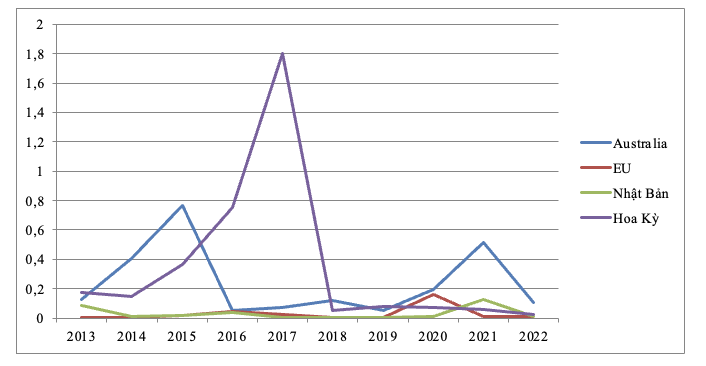
Compared with the EU, Japan, and the United States, Australia is the country with the highest Unit Rejection Rate (URR) for imported agricultural/food products (According to statistics from the United Nations Industrial Development Organization (UNIDO)).
Figure 1: Unit rejection rates for agricultural/food products of Australia, EU, Japan, US in the period 2013-2022
Source: United Nations Industrial Development Organization, 2024
There are many different reasons why agricultural/food products are refused to be imported into Australia, such as violations of labeling regulations, mycotoxins, bacterial contamination, heavy metals, additives, etc. In the period 2010-2022, Vietnamese agricultural/food products were refused to be imported into Australia, mainly due to violations of labeling regulations, with 376 refusals (accounting for 47.59% of the total number of refusals), followed by exceeding veterinary drug residues (accounting for 17.97%), contaminated agricultural/food products (accounting for 16.2%) and exceeding pesticide residues (accounting for 13.16%) (Data from the United Nations Industrial Development Organization, 2024).
Thirdly, the level of competition in the Australian market is very high, with major competitors all in the same region such as China, Japan, Korea, and some ASEAN countries. These countries have a structure of goods exported to Australia that is quite similar to Vietnam, so the level of competition is even higher. In addition, countries that have FTAs with Australia and countries that enjoy Australia's ASTP preferential mechanism also create certain competitive pressure on Vietnamese goods in this market. Moreover, even in areas with strong products, Vietnamese goods do not necessarily have advantages in quality, diversity and brand compared to these competitors.
Fourth, the cost of producing and exporting goods to the Australian market is relatively high. As mentioned, Australia's system of requirements, technical barriers as well as food safety measures, etc. is very strict, ensuring that imported goods must absolutely comply. Therefore, the cost that Vietnamese enterprises have to pay to ensure compliance with Australian requirements/regulations is significantly higher than many other export markets. Furthermore, the geographical distance between Vietnam and Australia is quite large, the cost of transporting goods from Vietnam to this country is also more expensive.
Source: Center for WTO and International Trade
