


Handbook on FTA Commitments for the Footwear Industry
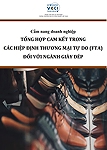

Time: 2018
By: WTO and International Trade Center - VCCI
The footwear industry is one of Viet Nam’s key export sectors, recording stable growth in export turnover and consistently ranking among the country’s leading export products. During the period 2011-2015, footwear exports accounted for 6.8% of Viet Nam’s total export turnover, with an average annual growth rate of 18.6%. Together with China, India, and Brazil, Viet Nam has consistently been among the world’s largest footwear-exporting countries.
From a tariff perspective, following Viet Nam’s accession to the World Trade Organization (WTO) in 2007, Vietnamese exports in general, and footwear products in particular, gained access to global markets under Most-Favoured-Nation (MFN) tariff rates on an equal footing with other WTO Members.
However, it was only with the conclusion of Free Trade Agreements (FTAs), under which the majority of tariff lines are eliminated either immediately or according to specific schedules that stable preferential market access for Vietnamese exports truly emerged. As a key export product, footwear has always been a priority sector for Vietnamese negotiating delegations in requesting tariff liberalization from FTA partners. As a result, FTAs have opened up particularly important opportunities for footwear exports.
As of January 1, 2018, Viet Nam had signed and implemented 10 FTAs, concluded negotiations on 2 FTAs, signed 1 FTA, and was negotiating 3 additional FTAs, involving a total of 57 trading partners worldwide.
The conclusion and implementation of FTAs provide Vietnamese footwear enterprises with opportunities to benefit from preferential tariff rates and reduced trade barriers when exporting to FTA partner markets, thereby enhancing competitiveness and strengthening the international presence of Vietnamese footwear products. In addition, FTAs offer opportunities to attract investment, capture domestic market share, and promote enterprise reform in line with international standards, ensuring sustainable development of the sector.
Within the framework of the Programme on Advisory Support and Integration Information for Vietnamese Enterprises of the WTO and Integration Center – Viet Nam Chamber of Commerce and Industry (VCCI), the HANDBOOK ON FTA COMMITMENTS FOR THE FOOTWEAR INDUSTRY has been compiled with the aim of providing Vietnamese footwear enterprises with an overview of the core commitments under the FTAs that Viet Nam has implemented or will implement, thereby enabling enterprises to make the most effective use of opportunities arising from these agreements.
The Handbook summarizes key commitments on tariffs and rules of origin related to footwear products under 14 FTAs that Viet Nam has signed or completed negotiations on, as well as selected information from FTAs currently under negotiation. These include commitments on tariff reduction schedules, rules of origin, and certificates of origin (C/O). In addition, the Handbook proposes several practical notes and recommendations for Vietnamese footwear enterprises to help maximize the benefits offered by the aforementioned FTAs.
It is hoped that the HANDBOOK ON FTA COMMITMENTS FOR THE FOOTWEAR INDUSTRY will serve as a useful reference for enterprises and industry associations in the process of international economic integration.
For further information, please contact: Ms. Nguyen Thanh Tra, WTO and International Trade Center - VCCI, Tel: (+84) 24-35771458, Email: banthuky@trungtamwto.vn.
The Table of contents of this Handbook (in Vietnamese) is attached below:
 Handbook on FTA Commitments for the Footwear Industry - Table of contents
More stories
- Handbook on customs procedures for verifying the origin of goods under FTAs
- Q&A on the issuance of C/O EUR.1 and interpretation of UKVFTA rules of origin
- Business Guide to Trade Remedies in the CPTPP context
- Introduction to the Self-Certification of Origin mechanism in CPTPP
- Implementation of Rules of Origin in CPTPP - A 3-year journey since the Agreement came into force