


The implementation manual for non-tariff barriers (TBT and SPS)
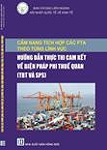

In line with the policy of proactive and active international economic integration pursued by the Party and the State, Viet Nam has gradually expanded and deepened its relations with other countries, while participating actively and responsibly in international forums and organizations. In particular, in recent years, in accordance with the broader trend of regional and global integration, Viet Nam has accelerated the negotiation and signing of free trade agreements (FTAs). To date, Viet Nam has participated in, or is in the process of negotiating, 16 FTAs, including 7 FTAs within the framework of intra- and extra-ASEAN cooperation and 11 FTAs negotiated and signed by Viet Nam as an independent party. Of these, 10 FTAs have entered into force, including the ASEAN Trade in Goods Agreement (the successor to CEPT/AFTA), FTAs between ASEAN and its partners—China, Japan, the Republic of Korea, India, Australia and New Zealand—as well as bilateral FTAs between Viet Nam and its partners, namely Chile, Japan, the Republic of Korea and the Eurasian Economic Union.
Viet Nam’s participation in FTAs with increasingly extensive and in-depth commitments requires State management agencies to provide specific guidance to enterprises and the public on the content, scope and implementation roadmap of these commitments. Enterprises, for their part, need to proactively study these commitments in detail in order to develop timely strategies to seize opportunities and overcome challenges arising during the implementation of FTAs.
Over the past period, a number of guidance materials have been developed to support understanding of individual FTAs. However, given Viet Nam’s participation in a large number of FTAs, there is a pressing need for materials compiled in a vertically integrated manner by specific sector or field, thereby facilitating comparison and cross-reference among commitments. This approach will support State management agencies and research institutions in obtaining an overall perspective for policy formulation. In particular, from the perspective of commitment implementation, such materials are highly necessary and useful for enterprises in understanding and applying FTA commitments in the process of expanding and diversifying markets and identifying business opportunities.
Against this backdrop, at the first meeting of the Inter-sectoral Steering Committee for International Economic Integration held on 12 September 2016, Deputy Prime Minister Vuong Dinh Hue, Head of the Steering Committee, assigned the Office of the Inter-sectoral Steering Committee for International Economic Integration to undertake the task of compiling vertically integrated FTA materials and handbooks for specific sectors and fields.
Pursuant to the Deputy Prime Minister’s direction, from December 2016 to September 2017, the Office of the Inter-sectoral Steering Committee for International Economic Integration coordinated with relevant ministries, sectors, agencies and organizations to compile the first three volumes in the series of integrated FTA handbooks, including:
Volume 1: Guidelines for the Implementation of Commitments on Non-Tariff Barriers (TBT and SPS);
Volume 2: Guidelines for the Implementation of Commitments on Intellectual Property;
Volume 3: Guidelines for the Implementation of Commitments on Trade Remedies and Dispute Settlement.
These commitments are provided for in most FTAs and always go hand in hand with market-opening commitments.
Each handbook includes the following contents: analysis and interpretation of commitments by field across the 10 FTAs that have entered into force; assessment of the compatibility of these commitments with Viet Nam’s current laws and regulations; and practical guidance for enterprises to apply these commitments during the implementation of FTAs.
Despite considerable efforts, due to the specific nature of the language used in FTAs and the need to interpret commitments across all 10 FTAs by field, shortcomings in this first edition are unavoidable. The drafting team would highly appreciate comments and feedback from readers in order to improve future editions.
The publication (in Vietnamese) is attached below:
 Handbook on the Implementation of Commitments on Non-Tariff Barriers (TBT and SPS)
More stories
- Handbook on customs procedures for verifying the origin of goods under FTAs
- Q&A on the issuance of C/O EUR.1 and interpretation of UKVFTA rules of origin
- Business Guide to Trade Remedies in the CPTPP context
- Introduction to the Self-Certification of Origin mechanism in CPTPP
- Implementation of Rules of Origin in CPTPP - A 3-year journey since the Agreement came into force