


Most viewed articles


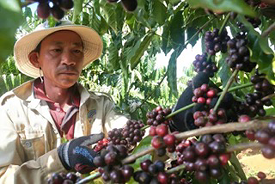
Viet Nam’s coffee sector is accelerating exports and generating substantial foreign exchange earnings. However, further promoting deep processing would undoubtedly deliver significantly higher added value.
Exports in subsequent years have been higher than in the preceding year
According to the Ministry of Agriculture and Environment, Viet Nam’s coffee export turnover stood at approximately US$3 billion in 2021. In subsequent years, the growth momentum accelerated markedly, reaching US$9 billion by 2025. This surge was primarily driven by rising global coffee prices.
Specifically, the average export price was below US$2,000 per ton in 2021 but climbed to US$5,660 per ton by 2025, representing an increase of 183 percent.
In the first quarter of this year, total coffee exports reached 577,300 tons, up 12.6 percent year-on-year. However, export value was estimated at US$2.71 billion, down 6.4 percent compared to the same period last year. The main factor behind this decline was a drop in the average export price to US$4,696.8 per ton.
Despite Viet Nam’s coffee exports continuously setting new records, the share of deeply processed coffee remains modest at around 15 percent of total output, with the remainder still exported in the form of green coffee beans.
According to Mr. Nguyen Quoc Manh, Deputy Director General of the Department of Crop Production and Plant Protection under the Ministry of Agriculture and Environment, foreign-invested enterprises account for a significant proportion of deeply processed coffee exports, while domestic enterprises mainly act as intermediaries in procurement.
In addition, value chain linkages remain weak. Smallholder farmers currently account for approximately 90 percent of total output, yet production is fragmented, quality is inconsistent, and there is a lack of sustainable certifications. The connection among farmers, cooperatives, and processing enterprises remains limited, leading to difficulties in meeting stringent requirements on traceability, particularly under the European Union’s Regulation on Deforestation-free Products (EUDR).
Promoting deep processing
According to a number of experts, following a period of rapid growth, global coffee prices may enter a downward cycle. Therefore, it is imperative to accelerate deep processing, including roasted, ground, instant, and capsule coffee, while enhancing raw material standards to ensure sustainable development.
In Dak Lak Province, Mr. Nguyen Thien Van, Vice Chairman of the Provincial People’s Committee, stated that the province currently has more than 200,000 hectares of coffee, with an annual output of approximately 165,000 tons. Long regarded as the country’s “coffee capital,” the locality boasts large-scale production and a long-standing cultivation tradition.
Accordingly, Dak Lak has identified deep processing as one of the strategic pillars of its coffee sector. The orientation is to link deep processing with high-quality raw material areas while strengthening the connection between enterprise brands and local as well as national brands in order to maximize the value derived from each coffee bean.
Analyzing the role of deep processing, Mr. Thai Nhu Hiep, Chairman of the Board of Directors of Vinh Hiep Co., Ltd., noted that while the price of raw coffee beans at around VND100,000 (US$3.79) per kilogram is often considered high, consumers readily accept paying approximately VND50,000 (US$1.89) for a cup of coffee. It should be noted that one kilogram of green coffee beans yields about 0.8 kilograms of roasted and ground coffee, which can be used to brew around 40 cups. This clearly explains why Viet Nam’s coffee sector needs to strongly promote deep processing, Mr. Hiep emphasized.
Addressing how to promote deep processing, Mr. Nguyen Thanh Tai, member of the Executive Committee of the Viet Nam Coffee Cocoa Association (Vicofa), pointed to practical approaches starting from small-scale coffee shops. Initial investment costs, particularly for roasting and grinding machines, range from VND30 million (US$1,138) to over VND300 million (US$11.138).
However, when expanding into stages such as roasting, instant processing, extraction, or the production of beverage ingredients, enterprises will gradually establish a multi-tiered value chain structure. To achieve this, businesses are required to make systematic investments in raw material areas, preliminary processing, logistics, and data management systems.
In addition, deep processing opens up significant opportunities for developing a circular economy within the coffee sector. Processing requires substantial capital investment, but it is an inevitable pathway for the sustainable development of Viet Nam’s coffee industry, Mr. Nguyen Thanh Tai emphasized.
According to Mr. Trinh Duc Minh, Chairman of the Buon Ma Thuot Coffee Association, around 70 percent of Viet Nam’s coffee output is still produced under traditional practices, lacking comprehensive traceability data required by new international standards such as the European Union’s Regulation on Deforestation-free Products (EUDR). These requirements compel the coffee sector to ensure full transparency across the entire supply chain, from cultivation areas to export stages.
Building a system of quality standards associated with data and traceability has therefore become a mandatory condition for Viet Nam’s coffee industry to maintain a firm foothold in the international market.
The top 10 enterprises account for as much as 85.3 percent of Viet Nam’s export turnover in the processed coffee segment, most of which are foreign-invested enterprises (FDI). Leading the market is Nestlé Viet Nam, holding a dominant 22.5 percent share, followed by Outspan Viet Nam (14.6 percent) and Iguacu Viet Nam (9.4 percent), along with other major players such as Sucafina Viet Nam, URC Viet Nam, ILD Coffee Viet Nam, Tata Coffee Viet Nam, and Instanta Viet Nam.
The remaining market share is held by a limited number of domestic enterprises, including Phuc Sinh Group, Trung Nguyen Legend, and Vinacafe Bien Hoa.
Notably, in the domestic market, per capita coffee consumption has risen significantly, from 1.7 kilograms in 2015 to 3 kilograms in 2026, reflecting growing internal demand.
Source: SGGP
- USTR Makes Findings and Proposes Action in 60 Section 301 Investigations Relating to Failures to Take Action on Trade in Forced Labor Goods
- [VCCI] The US officially initiates a Section 301 Investigation into Vietnam on Intellectual property
- General Secretary and President To Lam's working visit to three ASEAN countries: Demonstrating the stature of proactive and constructive diplomacy.
- Viet Nam accelerates innovation drive as skilled workforce becomes key to science and technology growth
- The US is increasing controls on AI chip exports