


Japanese investors pour nearly $79 billion into Viet Nam
09/03/2026 418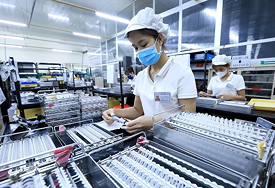
Most viewed articles


Highly appreciating the investment and business environment in Viet Nam, Japanese businesses have currently invested in 5,738 projects in Viet Nam, with a total investment capital of nearly 79 billion USD.
5,738 projects and nearly $79 billion.
Japan is currently the third largest foreign direct investor (FDI) among the 153 countries and territories worldwide with investment projects in Viet Nam (after South Korea and Singapore). According to data from the Foreign Investment Agency ( Ministry of Finance ), as of the end of February 2026, Japanese investors had invested in Viet Nam in 5,738 projects, with a total registered capital of US$78.977 billion.
In the first two months of 2026 alone, Japanese investors invested in 35 new projects in Viet Nam, adjusted capital for 19 projects, and contributed capital or acquired shares in 44 projects. The total investment capital from Japanese businesses in Viet Nam during those two months reached over $732 million, ranking fourth among the 60 countries and territories worldwide with investment projects in Viet Nam.
Among Japanese businesses investing in Viet Nam are many large corporations such as Canon, Honda, and Toyota. Their products are reputable, competitive, and technologically advanced, with many replacing imported goods and actively participating in export activities. Japan was one of the first countries to heavily participate in the automobile and motorcycle manufacturing and assembly industry in Viet Nam. Furthermore, Viet Nam's construction materials industry has also attracted large projects from Japan.
It can be said that FDI from Japan is of particular importance in the context of Viet Nam's prioritization of industrialization and modernization. Japanese businesses are considered to play a leading role in the development of supporting industries in Viet Nam.
Viet Nam has also approved the "Viet Nam's Industrialization Strategy within the Framework of Viet Nam-Japan Cooperation towards 2020, Vision 2030". This strategy prioritizes the development of six key industries: electronics; agricultural machinery; agricultural and aquatic product processing; shipbuilding; environment and energy saving; and automobile and auto parts manufacturing. The goal is to transform these six industries into leading sectors of the economy , with high added value and international competitiveness. These industries will play a leading role in attracting investment from domestic and foreign businesses, primarily Japanese businesses.
Expectations regarding Viet Nam's policy decisions.
Regarding the investment environment in Viet Nam, Mr. Yutaka Yasunaga, Director of Innovation at the Japan Trade Promotion Organization in Viet Nam (Jetro), stated: A survey on the business situation of Japanese companies abroad in 2024 showed that 56% of Japanese companies in Viet Nam plan to expand production. This is the highest percentage among Southeast Asian countries and ranks fourth globally among all countries where Japanese companies operate.
Furthermore, many Japanese businesses are interested in and investing in high-tech industries to capitalize on the potential of the Vietnamese market. For example, Panasonic has established an R&D (research and development) center in Hanoi, providing high value-added solutions focusing on information technology, digital transformation of manufacturing, cybersecurity, and the development of modern technologies.
According to Mr. Yutaka Yasunaga, Japanese businesses highly value the Vietnamese market. Specifically, 62% of Japanese businesses appreciate the market size and growth potential – much higher than the ASEAN average of 49%. In particular, the stable socio-political situation is a result of the government's efforts amidst increasing global tensions.
Also highly appreciating the investment and business environment in Viet Nam, Mr. Wakabayashi Koichi - President of the Japan Business Association in Viet Nam, said: The Japan Business Association is "grateful" for the far-sighted leadership of the Vietnamese Government, especially through four important resolutions, including: Resolution 57 of the Politburo - promoting science, technology and innovation; Resolution 59 on proactive and deep international integration; Resolution 68 on the development of the private economy; and Resolution 66 on comprehensive reform of the work of drafting and implementing laws.
“These pillars are crucial to Viet Nam’s future, and the Japanese business community strongly supports this direction,” affirmed Mr. Wakabayashi Koichi, adding that Japanese businesses investing in Viet Nam have shifted from labor-intensive industries to value-added industries, developing high value-added human resources, including research and development (R&D), capacity building, and energy transition projects, demonstrating a commitment to a green, competitive, and future-ready Viet Nam.
While highly appreciating the investment prospects of Japanese businesses in Viet Nam in the coming period, representatives of the Japan Business Association in Viet Nam also noted that legal regulations related to investment are still unclear, limiting the ability to resolve obstacles and slowing down project progress. In this context, the association recommended that the Government and relevant agencies continue to pay attention to, direct, and facilitate the implementation of projects by businesses.
The Japan Business Association in Viet Nam stated that Japanese businesses have built a system for developing highly skilled human resources and supporting the development of supporting industries, contributing to Viet Nam's deeper integration into the global value chain.
Source: Industry and Trade Review
- USTR Makes Findings and Proposes Action in 60 Section 301 Investigations Relating to Failures to Take Action on Trade in Forced Labor Goods
- [VCCI] The US officially initiates a Section 301 Investigation into Vietnam on Intellectual property
- General Secretary and President To Lam's working visit to three ASEAN countries: Demonstrating the stature of proactive and constructive diplomacy.
- Viet Nam accelerates innovation drive as skilled workforce becomes key to science and technology growth
- The US is increasing controls on AI chip exports