


Most viewed articles


The US administration's imposition of a temporary global tariff of 10% for 150 days is seen by Vietnamese export businesses as creating more opportunities to seek new and more promising orders from this market.
Although there are concerns about the risks of frequent changes in tax policies potentially impacting export activities in the long term, the adjusted tax rate of 10% is seen as good news for businesses in the early days of the new year.
Good news amidst declining orders.
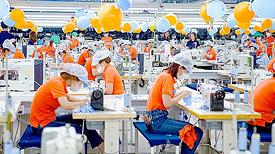
Speaking with us, Mr. Nguyen Duc Thang - CEO of Dap Cau Garment Joint Stock Company, which specializes in exporting garments to the US - said that orders and unit prices have dropped sharply by 15-20% since last October when the tariff order came into effect, making it impossible for the company to run its entire production line.
With orders coming in in small quantities and declining steadily over the past four months, the company has accepted almost every order to ensure the livelihoods of its workers and maintain factory operations. This is why, to protect its employees and keep the factory running, the company has accepted almost every order even without profit, as unit prices have also dropped sharply.
Therefore, given the news that the US has reduced tariffs to 10% for all countries, Vietnamese textiles and garments have a significant advantage over many competitors. Mr. Thang believes that Vietnamese businesses will have the opportunity to receive positive orders in the early part of the new year.
"In particular, Viet Nam is more competitive than many countries in Southeast Asia thanks to its skilled workforce, quality products, fast delivery times, ability to meet customer needs, and flexible pricing, so it remains a preferred choice even when the market fluctuates," Mr. Thang said.
Similarly, Mr. Dang Phuc Nguyen, General Secretary of the Viet Nam Fruit and Vegetable Association, also believes that the US imposing a 10% tariff on all countries is good news for Viet Nam's fruit industry in the early days of the new year. This is because the lower tariff than before will make exported goods more competitive and boost sales.
In fact, many types of Vietnamese fruit previously faced a 20% tariff when exported to the US market, higher than the 19% tariff of competitors. Therefore, with the new 10% tariff, equal to that of competitors, and given that Vietnamese fruit has an advantage over its competitors, its competitiveness is improved.
"Products are getting better and better in quality, so the market is buying more, export value is increasing, and products like durian are available year-round. The level of deep processing is also increasing, and since the US is a market that consumes a lot of processed goods such as durian, frozen goods, canned goods, fruit juices... this will be a big advantage," Mr. Nguyen commented.
However, according to Mr. Nguyen, this 10% tariff, implemented for 150 days, shows that the US market remains unpredictable due to its frequently changing tax policies. In particular, instead of applying tariffs, the US and many other fruit-importing countries are implementing management policies through technical barriers.
Accordingly, products are subject to stricter quality control with more stringent standards, green production, and stricter management of planting area codes. "Therefore, along with improving product quality, it is necessary to make good use of the advantages that the FTA brings to help Vietnamese goods compete better," Mr. Nguyen said.
Shift from quantity to quality to seize opportunities.
Mr. Mac Quoc Anh, Vice President and General Secretary of the Hanoi Association of Small and Medium Enterprises, said that the new US tariff policy needs to be viewed within the overall context of the US's global trade restructuring strategy aimed at reducing the trade deficit, re-industrialization domestically, and adjusting supply chains towards " economic security".
When the US imposed new universal import tariffs on many partners, the ASEAN region was directly affected because it served as a hub for alternative manufacturing in the post-US-China tensions period. From an economic standpoint, import tariffs increase the price of goods in the US market, reduce the competitiveness of exports, and narrow profit margins for businesses.
However, the new tax adjustments – if lower than the previous high reciprocal rates – could help reduce short-term pressure on some countries, including Viet Nam. Therefore, Mr. Quoc Anh believes the impacts are two-sided.
Firstly, because Viet Nam is one of the countries with a large trade surplus with the US, any tariff adjustments could create significant risks, not only in the tariff level itself, but also in the possibility of the US intensifying trade defense measures, origin controls, and anti-illegal transshipment efforts.
If higher tariffs are imposed or a wide-ranging investigation is launched, key industries such as electronics, textiles, footwear, and wood products will be significantly affected. Conversely, if tariffs are standardized at a reasonable level and are not highly discriminatory, Viet Nam may face a lighter burden compared to previous scenarios where it faced the risk of very high retaliatory tariffs.
Therefore, as the US prioritizes trade balance and protecting domestic production, countries with large trade surpluses like Viet Nam need to shift from a strategy of "increasing quantity" to "increasing quality." Accordingly, Vietnamese businesses need to reduce their dependence on a single market by fully leveraging FTAs such as CPTPP, EVFTA, and RCEP to expand and diversify export markets.
"In addition, Vietnamese businesses need to increase the localization rate, increase transparency in the supply chain and traceability system to reduce the risk of trade defense investigations. They should continue to invest in technology, automation, digital transformation, and ESG standards to increase added value and create products with high technological content and strong brands...", Mr. Quoc Anh said.
In addition, experts also expressed their desire for the Government and relevant ministries to continue maintaining high-level trade dialogue with the US to address issues such as trade imbalances, bilateral market access, and strategic investment cooperation.
"We must gradually shift from an export processing model to a model of deep participation in the value chain, developing supporting industries and the digital economy to overcome challenges and take advantage of opportunities from tariff policies for exports," an expert advised.
Source: The Youth Online
- USTR Makes Findings and Proposes Action in 60 Section 301 Investigations Relating to Failures to Take Action on Trade in Forced Labor Goods
- [VCCI] The US officially initiates a Section 301 Investigation into Vietnam on Intellectual property
- General Secretary and President To Lam's working visit to three ASEAN countries: Demonstrating the stature of proactive and constructive diplomacy.
- Viet Nam accelerates innovation drive as skilled workforce becomes key to science and technology growth
- The US is increasing controls on AI chip exports