

Most viewed articles


President Donald Trump imposed a 15% global tariff after the US Supreme Court rejected most of the previous policy, which upheld the metal tariffs and drug exemptions under the USMCA.
US President Donald Trump was forced to adjust his trade policy after the US Supreme Court invalidated most of the tariffs he had imposed worldwide .
According to Trump, this is "the most beautiful word in the dictionary." Since returning to the White House a year ago, Trump has implemented new additional tariffs on goods imported into the US from around the world. These tariffs range from 10-50%, depending on the country and circumstances.
On average, the tariffs imposed by Washington reached 17.98%, the highest since the early 1910s. Meanwhile, the theoretically average tariff rate was only 2.4% when he took office.
However, these tariffs have just been declared illegal by the U.S. Supreme Court. In a 6-3 vote, the ruling, drafted by Conservative Chief Justice John Roberts, upheld the lower court's decision that the President exceeded his authority by relying on a law that is only permitted in cases of a "national emergency."
This ruling invalidated most, but not all, tariffs. Tariffs on aluminum, copper, and steel, for example, remained unchanged and unaffected – unlike the country-specific tariffs.
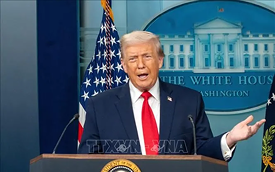
Calling the court's decision "ridiculous," US President Donald Trump imposed a new, uniform tariff: 15% on the entire world.
These tariffs are expected to take effect on February 24th and for a period of 150 days, with some exceptions: the pharmaceutical industry is exempt, and goods imported under the USMCA (United States, Canada, and Mexico) agreement are also exempt.
Even though the US has reached trade agreements with the European Union (EU), Japan, South Korea, Taiwan (China), and most recently India, the new 15% tariff will still be applied.
The two countries most heavily affected by previous additional tariffs were Brazil and India, with tariffs reaching up to 50%.
India faces tariffs for buying oil from Russia, while Brazil is criticized by Washington over an alleged “witch hunt” targeting former president Jair Bolsonaro, who was sentenced to 27 years in prison for plotting a coup.
Even Canada and Mexico, two of the United States' largest trading partners, are not exempt. Canada faces a 35% tariff on goods not covered by the USMCA agreement, while Mexico is subject to a 25% tariff, and trade negotiations continue beyond the planned October 30, 2025, deadline to resolve outstanding issues.
Source: VTV
- USTR Makes Findings and Proposes Action in 60 Section 301 Investigations Relating to Failures to Take Action on Trade in Forced Labor Goods
- [VCCI] The US officially initiates a Section 301 Investigation into Vietnam on Intellectual property
- General Secretary and President To Lam's working visit to three ASEAN countries: Demonstrating the stature of proactive and constructive diplomacy.
- Viet Nam accelerates innovation drive as skilled workforce becomes key to science and technology growth
- The US is increasing controls on AI chip exports