

Most viewed articles


It remains unclear when the 15% tariff announced by Mr. Trump will take effect and which goods it will apply to, while observers and US trading partners are maintaining a cautious stance, preparing for the possibility of tougher tariff policies.
On February 21 (US time), US President Donald Trump announced an increase in import tariffs on global goods to 15%, after the US Supreme Court rejected most of the previous "reciprocal tariffs."
"Plan B" tariffs
In response to the White House's moves, the Bangkok Post (Thailand) called it a "Plan B" for tariffs, suggesting that the Trump administration will have other measures to maintain its policy of taxing global goods.
According to the newly announced 15% tariff, for some countries this will be higher than the reciprocal tariffs currently in place. Mr. Trump said there would be exceptions for certain products and countries, but added that other tariff measures would follow.
Tariffs were already a major variable in global trade in 2025. The fact that this topic continues to be a hot topic starting in early 2026 risks prolonging uncertainty, forcing investors, businesses, and policymakers to constantly adjust their expectations.
The 15% tariff was invoked under Section 122 of the U.S. Trade Act of 1974. This provision allows the President to impose a maximum tariff of 15% for a period of 150 days, unless extended by Congress .
The fact that the law sets an application deadline raises hopes that the 15% tariff may not be extended, but it also makes the market wary of unpredictable developments.
Varg Folkman, an analyst at the European Policy Centre, believes that current developments signal “a new period of uncertainty” for international trade, as economies are forced to anticipate Washington’s next move.
Speaking to Tuoi Tre Online , National Assembly representative, Associate Professor Dr. Tran Hoang Ngan (Saigon University) stated that the world is currently in a state of "uncertainty," unpredictable and full of unusual fluctuations, while at the same time, the US tariff policy is constantly changing, continuing to have significant impacts.
"The US tariff policy is constantly changing, with projected figures fluctuating between 10%, 15%, or 20%, causing significant impacts on the global economy," Mr. Ngan stated, emphasizing that the US is a leading export market and any tariff adjustments will directly affect Viet Nam.
In addition to the 15% tariff, industry-specific tariffs based on Sections 301 and 232 remain in effect, suggesting that the US administration may continue to expand trade investigations in the future.
In this context, according to Mr. Ngan, Viet Nam needs to proactively develop multiple response scenarios instead of waiting for developments from the outside. "A lack of proactiveness will make it difficult for export businesses to plan raw material procurement, sign contracts, and negotiate prices," he recommended.
Vietnamese businesses need to continue to be proactive.
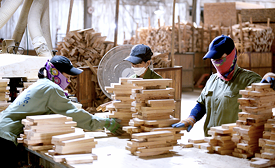
The Vietnamese timber industry was also affected by investigations under Section 232. However, at the end of 2025, President Trump signed a declaration adjusting import tariff policies on wood, lumber, and wood derivatives under Section 232. Accordingly, the US decided to postpone the tariff increase on some finished wood products such as upholstered chairs, kitchen cabinets, and bathroom cabinets from January 1, 2026, to January 1, 2027.
Previously, in an interview with Tuoi Tre Online on the sidelines of a Viet Nam-US trade conference, Mr. Nguyen Chanh Phuong, Vice Chairman and General Secretary of the Ho Chi Minh City Handicraft and Wood Processing Association (HAWA), stated that even with a 20% reciprocal tariff, Viet Nam's wood exports to the US still recorded positive growth.
However, according to Mr. Phuong, the greater risk lies in the possibility that investigations under Section 232 could lead to higher additional tariffs. Mr. Phuong hopes that the government's negotiation efforts, along with businesses being more proactive in meeting US requirements, will help maintain tariff levels that are competitive with other countries.
Mr. Phuong stated that in addition to proactively importing raw timber from the US, Vietnamese businesses will need to continue to proactively maintain a traceability system, manage the supply chain, and enhance their competitiveness.
Regarding the motivation for Vietnamese businesses to improve their production capacity to better cope with tariffs, Professor David Dapice (retired economics professor at Tufts University, USA) noted that another unpredictable factor in the tariff landscape with the US is the Trump administration's definition of "goods in transit."
According to Professor Dapice, Washington would prefer that Vietnamese exports have more added value from products manufactured in Viet Nam.
Source: The Youth online
- USTR Makes Findings and Proposes Action in 60 Section 301 Investigations Relating to Failures to Take Action on Trade in Forced Labor Goods
- [VCCI] The US officially initiates a Section 301 Investigation into Vietnam on Intellectual property
- General Secretary and President To Lam's working visit to three ASEAN countries: Demonstrating the stature of proactive and constructive diplomacy.
- Viet Nam accelerates innovation drive as skilled workforce becomes key to science and technology growth
- The US is increasing controls on AI chip exports