


Appropriate trade approach critical
26/05/2025 55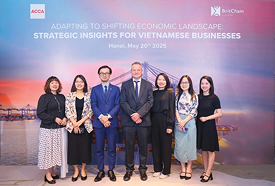
Most viewed articles


Vietnam is accelerating efforts to strengthen economic resilience through targeted reforms, digital transformation, and the diversification of export markets.
These aspects were at the heart of a high-level roundtable held in Hanoi on 20 May by the Association of Chartered Certified Accountants (ACCA), bringing together CEOs, industry experts, and ACCA executives to discuss the macroeconomic headwinds shaping 2025. The discussion provided critical insights into the challenges posed by global economic fluctuations and the strategies needed to build resilience in an increasingly volatile trade environment.
A key theme emerging from the roundtable was the growing dominance of trade-related uncertainties on the global economic agenda. Participants agreed that economies deeply integrated into international trade networks, like Vietnam, will feel these pressures most acutely.
Mike Suffield, director of Policy and Insights at ACCA Global, highlighted that Vietnam’s response to these challenges could serve as a valuable example of economic resilience.
“As a country closely linked to global trade flows, Vietnam’s approach will be especially instructive,” he said. “Against this backdrop, the ACCA is preparing to release a comprehensive report on global trade disruptions this September. The report aims to offer detailed guidance for governments and businesses navigating the increasingly complex trade environment.”
Suffield also noted a significant drop in global business confidence, now at its lowest level since the second quarter of 2020. However, despite this bleak outlook, a modest rebound in new orders points to underlying demand that persists amid the uncertainty. “The decline in confidence is most pronounced in North America, where US sentiment has plummeted to historic lows since the ACCA’s survey began in 2011. This downturn can be attributed to rising protectionism and substantial federal spending cuts, factors that continue to weigh heavily on the economic outlook,” he added.
While the current pause in the US-China tariff escalation offers some temporary relief, Suffield warned that this reprieve is fleeting and should be leveraged to work towards more sustainable trade frameworks.
“Compounding these challenges, US consumer sentiment has deteriorated sharply. Inflation expectations have surged beyond 6 per cent, the highest since 1981, while declining real incomes and weak equity markets threaten both consumption and private investment,” he explained.
Despite these headwinds, Suffield remains cautiously optimistic. He pointed out that there is still a possibility the US could avoid a recession if trade negotiations succeed in easing tensions. However, he emphasised that uncertainty will likely continue to shape the global economic outlook for the foreseeable future.
In this context, technological innovation is emerging as a key lever for resilience. Speaking at the roundtable, Nguyen Thi Phuong, consulting director at FPT IS, said that digital transformation is a fundamental shift in how global trade operates.
“Amid rising geopolitical tensions and shifting tax regimes, technologies such as AI, blockchain, and automation are enabling businesses to streamline customs processes, optimise supply chains, and respond more nimbly to disruptions,” Phuong said.
She noted that digital adoption is no longer optional. “Many CFOs recognise that market and supply chain diversification are essential, but manual processes cannot keep pace with today’s complexity. Digital technologies offer the scalability and flexibility required to thrive,” she added.
However, while Vietnam has made strides in digitalisation, major gaps remain. Trade processes often involve multiple, disconnected systems, ranging from banks and insurers to shipping lines and customs authorities, making real-time coordination difficult.
To address these challenges, FPT and a partner introduced a digital trade finance platform in 2023, establishing a unified gateway that automates documentation, enhances transparency, and reduces operational costs. “This integration helps streamline trade processes and strengthens Vietnam’s competitiveness, reinforcing its appeal to global partners,” Phuong noted.
Even as digital innovation continues to transform operations across sectors, strategic trade policy remains a cornerstone of Vietnam’s economic resilience. Pham Vu Thang Long, senior research director and head of Macroeconomics at Ho Chi Minh Security Corporation, highlighted the urgency for Vietnam to diversify its export markets, fully leverage existing free trade deals, and accelerate the transition towards more sustainable production models.
Encouragingly, Vietnam’s export performance has shown robust momentum, defying broader global headwinds. According to Long, export turnover surged nearly 30 per cent in March and April, propelling on-year growth for the first four months of 2025 to over 25 per cent.
“Despite rising tariffs and a shifting trade landscape, Vietnam’s export sector remains remarkably resilient, supported by structural strengths, strategic trade policies, and a dynamic workforce,” Long observed.
In addition, Vietnam’s active participation in free trade agreements has further broadened its preferential access to diverse markets. Although a bilateral trade deal with the US is still under negotiation, Long emphasised that Vietnamese products are already maintaining a strong presence.
“Diversification is no longer merely a strategic goal, it has become an imperative,” he said. “By broadening market reach, strengthening digital infrastructure, and maintaining agility amid external shocks, Vietnam is well-placed to mitigate emerging risks and also set a benchmark for resilient and adaptive trade across Asia-Pacific and beyond.”…
Source: Vietnam Investment Review
- US tariff threats over forced labour 'unjustified', Commission says
- US Section 301 Forced Labor Investigation: New Trade Compliance Risks for Viet Nam Exporters
- US cites forced labor concerns as grounds for new tariffs
- Aquatic products face challenge of maintaining market share in US
- Viet Nam extends anti-dumping duties on some Thai sugar products to 2031