
Most viewed articles


VNA reporter interviewed VCCI Chairman Pham Tan Cong about the risk of global trade war; as well as recommendations to adapt to this challenging context.
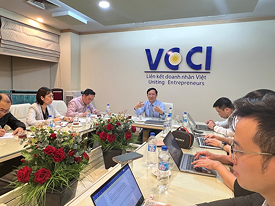
After more than a week of turmoil with a range of emotions surrounding the "earthquake" of the US's reciprocal tariffs, the alarm bell has once again sounded about a rapidly changing and unpredictable trade order, with no time for "slowness". On April 11, at the headquarters of the Vietnam Federation of Commerce and Industry (VCCI), VNA reporters interviewed VCCI Chairman Pham Tan Cong, assessing the current situation, the perspective of business community representatives on the risk of a global trade war; as well as recommendations for the Government, sectors and businesses to adapt to this challenging context.
Reporter: How do you assess the current situation and general difficulties of global trade, especially after the move to impose reciprocal tariffs on imported goods from abroad to the United States by the Trump Administration?
VCCI Chairman Pham Tan Cong: Currently, the world trade picture has changed a lot. Protectionism is gradually returning with conflicts between the two trends of protectionism and free trade...
The United States is a large market. In the era of globalization and free trade, the above mentioned tax imposition is a shock. It can be imagined that, like when the flow of global trade is blocked, the consequences are unpredictable.
The reaction of many countries to this shock has been very harsh, even among those who are allies of the US. There are many conflicting views, but it is undeniable that just one change has caused a chain reaction that has caused the whole world to fall into a trade "earthquake" in recent days.
Reporter: It seems that this is not the first time Vietnam has faced such a big challenge from the shock of international trade?
VCCI Chairman Pham Tan Cong: It is true that for Vietnam, this is not the first time we have encountered such a big shock. Looking back 30 years ago, when Vietnam began its renovation process, it also had to face extremely difficult situations when the economies of the former Eastern European countries disintegrated...
Now, we are starting a new era, but Vietnam's largest export market, the leading economic partner, the United States, has changed its entire strategy. I believe that we have learned from previous lessons. In common difficulties, Vietnam always finds new development drivers; even taking advantage of the situation to see "opportunities" in "danger" and "fly" up. Now is the time, we need to identify, find a new path of development. This context really needs calm, then there will be a solution!
Reporter: How do you evaluate the response of the Government and all levels of sectors in this context?
VCCI Chairman Pham Tan Cong: In recent days, the Government, sectors and businesses have been very active in seeking solutions. After the talks between General Secretary To Lam and President Donald Trump, the Government and the General Secretary's Special Envoy are on their way to the US to work very proactively and positively, making efforts to promote a common direction for negotiations to achieve the most favorable results.
Domestically, the Vietnam Federation of Commerce and Industry also created a specialized group, actively working and coordinating with organizations and industry associations such as the American Chamber of Commerce in Vietnam (AmCham) or the American Chamber of Commerce in Washington to support the Vietnamese Government in finding solutions to overcome difficulties. VCCI also sent letters and immediately received supportive responses from other friendly partners such as the Los Angeles Chamber of Commerce and the San Francisco Chamber of Commerce to create a business alliance, unanimously speaking out against President Donald Trump's tariffs. The creation of a common voice and the support of the US business community, along with the reaction of the global stock market, created great pressure, forcing the Donald Trump administration to announce a 90-day delay in imposing tariffs.
For governments, these 90 days are a period of time to negotiate in order to reach the best agreement for businesses. For businesses, this is also an opportunity to take advantage of these 90 days of truce to deal with business issues such as: signed contracts, handling of goods, how will the production line be, what is the plan to resume the market?
This is the time when countries need to cooperate in negotiating to reach an agreement, as doing it alone would be very disadvantageous. Specifically, in the ASEAN Community, each country may have its own characteristics, but there needs to be agreement on common principles such as promoting global free trade, respecting and complying with international trade laws, etc.
For Vietnam, in the next 90 days, there are things that need to be done. First, we must prioritize negotiations to achieve the best results, ensuring that Vietnam does not lose its inherent competitive advantages and that any setbacks must be within the tolerance of Vietnamese businesses.
Second, it is necessary to identify solutions and develop scenarios to maintain a proactive stance in adaptation. If the negotiations achieve high, average or low results, what are the corresponding solutions to handle the situation? What will be the strategy, orientation for economic development and policies to support businesses and people?
This is also an opportunity for us to review and transform, certainly requiring strategies. That is to continue efforts to innovate institutions and the business environment; to diversify markets and products; to redefine Vietnam's strengths and competitive advantages in the coming time. This is also the right time to promote and have the motivation to change according to the strategies that the Party and Government are advocating such as arranging and streamlining the State apparatus, rearranging localities to create new development space, promoting science and technology strategies... to increase competitiveness and enhance the value and position of Vietnam.
Market diversification needs to be viewed more broadly by choosing new pillars of the economy. That is, developing the domestic market in parallel with exports. Along with opening up more space for new markets through signing Free Trade Agreements (FTAs), it is also necessary to further promote policies and support mechanisms to promote domestic consumption; allocate a portion of increased budget revenue to support business development in parallel with promoting public investment.
The important thing to do is to support businesses to expand their markets, transform technology, financial tools, land, create more funds, and incentive programs for business development. Thanks to that, businesses will not only improve their competitiveness but also be able to turn the situation around, find ways to reverse the flow of goods, and turn Vietnam into an international commodity trading center in the near future.
Source: Bnews (Vietnamese)
- US tariff threats over forced labour 'unjustified', Commission says
- US Section 301 Forced Labor Investigation: New Trade Compliance Risks for Viet Nam Exporters
- US cites forced labor concerns as grounds for new tariffs
- Aquatic products face challenge of maintaining market share in US
- Viet Nam extends anti-dumping duties on some Thai sugar products to 2031