


Most viewed articles


China is “strongly dissatisfied with and firmly opposed” to Washington’s finalised plans to increase tariffs on a range of key Chinese industries, from electric vehicles and photovoltaic cells to semiconductors.
“The United States should immediately correct its wrong practices and cancel all tariff increases on China,” the Ministry of Commerce said over the weekend in response to the US announcement.
“China will take necessary measures to resolutely defend the interests of Chinese enterprises.”
The ministry said Washington’s decision would not only seriously undermine the “international trade order” and “global industrial chain and supply chain”, but also failed to address the US trade deficit and industrial competitiveness.
“[The actions will] push up the prices of US imports, with the costs ultimately borne by US businesses and consumers,” it added.
The comments followed the US Trade Representative’s (USTR) announcement on Friday confirming tariffs ranging from 25 per cent to 100 per cent on hundreds of products.
The tariffs were proposed by the White House in May and vetted by the USTR as part of a review under Section 301 of the Trade Act of 1974.
According to the USTR’s report, duties on Chinese EVs will quadruple to 100 per cent, and a 25 per cent tariff will apply to Chinese EV batteries, with both taking effect in two weeks. Chinese lithium-ion batteries not used for EVs will also have a 25 per cent tariff from 2026.
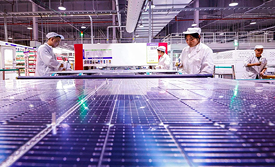
Semiconductors and solar cells – two other key sectors in China’s move up the industrial chain – will also be subject to 50 per cent tariffs starting next year and this year respectively.
In addition, 100 per cent duties will apply to some medical products, including syringes, needles and medical gloves. Tariffs on ship-to-shore cranes will rise to 25 per cent.
The China Council for the Promotion of International Trade also expressed opposition to the final tariff measures targeting China.
“[The move will] seriously affect the confidence in the long-term and stable cooperation between the relevant industries of China and the US, and adversely affect cooperation in the global industrial supply chain,” the council said.
“Recently, a delegation of Chinese entrepreneurs organised by the council visited the US … and both sides unanimously called for respecting the market principle and the spirit of the contract, and opposing trade protectionism.”
Under Section 301, the US can impose trade sanctions on countries that violate trade agreements or engage in “unjustifiable” or “unreasonable” acts that burden its commerce.
US Trade Representative Katherine Tai said the tariff actions “will target the harmful policies and practices of the People’s Republic of China that continue to impact American workers and businesses”.
“These actions underscore the Biden-Harris administration’s commitment to standing up for American workers and businesses in the face of unfair trade practices.”
The USTR’s decision comes in the countdown to the US general election in November, a race contested by former president Donald Trump, who triggered the US-China trade war by becoming the first to impose such tariffs on Chinese imports during his four years in office from 2017.
In 2018, the World Trade Organization officially questioned the USTR’s conclusions in a Section 301 investigation into China’s intellectual property practices.
During the presidential debate last week between Trump and US Vice-President Kamala Harris, the Democratic Party’s presidential candidate, Harris accused Trump of “inviting trade wars” but failing to prevent China from gathering American chips to help it “improve and modernise their military”.
The final tariffs also signalled a step backwards for recent bilateral engagement.
US national security adviser Jake Sullivan visited China late last month in what was widely seen as an attempt to pave the way for another face-to-face meeting between Chinese President Xi Jinping and his US counterpart Joe Biden.
Source: South China Morning Post
- New-generation FTAs open wider export opportunities to Middle East and South Asia
- The new FTA provides a boost for Vietnamese goods to enter the Halal market
- Patents become new competitive weapon for cooperatives
- Resolution 10-NQ/TW marks significant upgrade in Viet Nam’s FDI approach
- DDG Nordquist: WTO remains the foundation of global trade despite growing challenges