


Vietnam anticipating opportunities of semiconductor industry
01/11/2023 116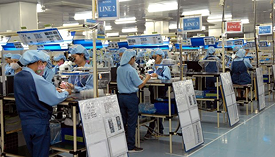
Most viewed articles


Thorough preparations, especially in human resources training, are needed for Vietnam to anticipate opportunities of the semiconductor industry expected to continue growing rapidly in the coming time.
According to experts, with many advantages, Vietnam is emerging as a key market for large global semiconductor manufacturers.
In September, Hana Micron, a major business in the Republic of Korea (RoK)’s semiconductor industry, inaugurated a semiconductor manufacturing factory in Bac Giang province, the first of its kind in the northern region. With this project, Hana Micron’s total investment in Vietnam now stands at 600 million USD. This year, the company’s revenue is expected to reach 300 million USD. It plans to raise its investment to over 1 billion USD by 2025. At that time, the factory is set to gain 800 million USD in revenue and create over 4,000 jobs.
One month later, the RoK's Amkor Technology, Inc., a global semiconductor packaging and test service provider, inaugurated its factory in Bac Giang’s neighbouring province of Bac Ninh.
Amkor Technology Vietnam, located at Yen Phong II-C with a total investment of 1.6 billion USD by 2035, is one of the largest semiconductor manufacturing plants in Vietnam.
Recently, Vietnam’s National Innovation Centre (NIC) signed memoranda of understanding with three major US partners, namely Synopsys, Cadence Design Systems, Inc., and the University of Arizona. In particular, the NIC's cooperation with Synopsys and the University of Arizona focuses on human resources development for the semiconductor industry in Vietnam, while its cooperation with Cadence involves promoting design capacity and developing semiconductor products in the country.
In addition, the Ministry of Education and Training also signed a memorandum of understanding with Intel Corporation on developing human resources for high-tech industries.
Several technology units and enterprises such as Viettel, FPT, and CMC have also researched, designed, and manufactured integrated circuits (ICs), which is considered a way for Vietnam to participate more deeply in the global semiconductor industry.
Determining human resources training as a fundamental issue for this industry, the Government has assigned the Ministry of Planning and Investment, the Ministry of Information and Communications, and related ministries and sectors to develop an action programme on developing the sector in Vietnam, and build a human resources development project with a goal of forming a contingent of 50,000 engineers for it by 2030./.
Source: Vietnam Plus
- Viet Nam’s trade surplus with EU expands amid economic headwinds
- Steel, cement and electricity firms to trade emissions quotas under Viet Nam's carbon market
- VCCI proposes 11 recommendations to quantify support for SMEs
- Trump’s copper tariff decision hangs over global metal market
- Global capital sees potential in Europe but calls for lighter regulation