


Most viewed articles


In a report sent to the National Assembly Standing Committee recently, the Ministry of Industry and Trade, authorized by the Government, raised a series of problems related to the fact that it has not been able to provide regulations and conditions on what goods are made in Vietnam. South, applicable to goods circulating in the country.
The Ministry of Industry and Trade said that the “made in Vietnam” regulation was proposed by the government to be developed in 2018.
However, one of the problems that makes it difficult to establish criteria of origin for goods manufactured in Vietnam after 5 years is that there is no regulation on criteria and conditions for enterprises to identify and display goods. The label on the package is “Vietnamese product” or “made in Vietnam”.
According to the Ministry of Industry and Trade, at first, the ministry reported to the Government to develop a circular “made in Vietnam”. However, in 2019, the content of the circular, after consulting ministries and branches, generated policies beyond the authority of the Ministry. Therefore, the Ministry of Industry and Trade has requested to change direction to develop a decree “made in Vietnam”.
By 2021, the Government will issue Decree 111/2021/ND-CP (Decree 111) amending and supplementing Decree 43/2017/ND-CP on goods labels. The content on how to label goods has been included in Decree 111.
That is, the “made in Vietnam” regulation will only focus on providing a set of origin criteria to identify goods made in Vietnam, which is the basis for labeling the origin of goods. According to the assessment of the Ministry of Industry and Trade, at this time, it is no longer necessary to develop a document “made in Vietnam” at the decree level.
In May 2022, the Government agreed to allow the Ministry of Industry and Trade to return to developing regulations at the circular level instead of the decree level. However, the problems of issuing authority are “twisting” with the functions and tasks of the Ministry of Industry and Trade.
The economy is difficult, worrying about businesses is more burden?
Another reason for the delay in completing the development of regulations is that the regulation at the circular level on “made in Vietnam” goods will have a stricter legal status than the current regulations for domestic goods. Therefore, “potential legal risks, easy to face negative reactions from businesses”.
Besides, in fact, when the circular has not been issued yet, enterprises are still performing the identification of manufactured goods in Vietnam according to the principles of Decree 111.
In 5 years of implementing regulations, the Ministry of Industry and Trade has only received a number of documents from 16 businesses asking for guidance on determining whether goods are allowed to be labeled made in Vietnam or not.
Another reason for not being able to issue criteria for ‘made in Vietnam’ goods is the fear of incurring a burden of compliance costs for businesses.
In theory, the circular’s provisions only apply when traders have a need to label “made in Vietnam” with their goods (that is, goods that want to be labeled with this label will be adjusted). In case the goods are not recorded as Vietnamese origin, this policy will not be affected.
However, according to Decree 111, the regulation “origin of goods” is a mandatory content on goods labels. Accordingly, all goods manufactured in Vietnam will have to comply with regulations and criteria if the authorities issue a Circular “made in Vietnam”, except for goods of foreign origin. Therefore, if this regulation is enacted, it will have a great impact on businesses.
In addition, import-export businesses are familiar with concepts in the field of origin such as value content, code conversion, HS code; There are human resources and accounting system to calculate the parameters, so compliance is not difficult.
But this regulation will be an obstacle for businesses, small production facilities, individual business households, and may even incur large compliance costs for businesses.
In particular, when traceability activities in Vietnam still have many difficulties, determining the origin and origin of each component and raw material is not easy and very expensive.
In the context of a difficult economy, the Ministry of Industry and Trade said that it is not appropriate to issue new regulations and conditions, potentially incurring compliance costs for businesses.
This agency will work with the Ministry of Justice to study and handle problems regarding the authority to issue circulars and consider promulgating this regulation according to its competence at an appropriate time to minimize the impact on production activities. production and business of enterprises.
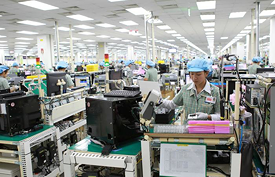
Producing 210 million ‘made in Vietnam’ phones, 50% sold to China and the USIn 2022, Vietnam produces about 210.5 million phones, of which exports to China and the United States account for nearly half.
Source: Vietnam Posts English
- China retaliates against US blacklist, targets defence and rare earth firms with export controls
- Rising global shipping costs put pressure on Viet Nam’s seafood exporters
- Customs force tightens crackdown on intellectual property-infringing goods
- Continued resilience of Viet Nam's economy
- Viet Nam’s trade deficit raises structural concerns: opinion