


Most viewed articles


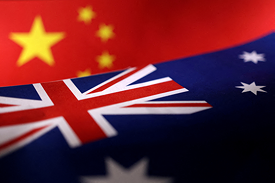
Australia reported a fifth consecutive year of trade surpluses and opened 2023 with the enticing prospect of further bolstering overseas shipments as it reheats relations with the world’s second-largest economy.
Australia and China’s top trade officials met Monday for the first time since 2019, in the latest sign of thawing diplomatic ties. Trade Minister Don Farrell and Commerce Minister Wang Wentao held virtual talks for over 90 minutes.
Australia’s ties with China had frayed since 2018 when it barred Huawei from building its 5G network, and went into freefall in 2020 as then-Prime Minister Scott Morrison called for an independent probe into the origins of coronavirus in Wuhan.
Beijing responded with a volley of punitive trade actions that hit Australian commodities ranging from coal to barley, lobsters and wine.
Broadly, Australia’s exports have been underpinned in recent times by demand for iron ore, coal and natural gas — with prices of the latter two fueled by Russia’s invasion of Ukraine. Services exports are likely to be boosted in 2023 — also by China — following Beijing’s decision to abandon Covid Zero.
Coal Thaw
Four Australian coal cargoes head to China amid softening in relations
“There is further upside due to the rapid reopening of the Chinese economy” and the government’s edict that students need to take classes in person, said Belinda Allen, a senior economist at Commonwealth Bank of Australia. “Tourism exports should also be a clear beneficiary given China was the largest source of tourism spend pre-pandemic.”
At its peak in 2019, Australian services exports accounted for 20% of total shipments and education made up around 40% of services. On its own, education was worth around $A40 billion ($27.7 billion) and represented 8% of total exports.
Despite the tensions, China remained Australia’s largest export destination as the government in Beijing didn’t try to restrict the massive and highly lucrative iron ore trade.
During Monday’s talks, Farrell accepted an invitation from his Chinese counterpart to visit Beijing in the near future for further discussions. The Australian minister had said previously that he would be raising China’s ongoing sanctions.
There’s never been any official confirmation of a ban on imports of lobster or coal and China has continued to insist that its trade restrictions are in line with World Trade Organization rules.
— Michael Heath in Sydney
Charted Territory
World Logistics Tensions Eased in January
Global logistics tensions moderated in January, falling near to the levels last seen in 2020, the Federal Reserve Bank of New York said. The Global Supply Chain Pressure Index declined to 0.95 standard deviations above is historical mean last month from 1.19 in December, the New York Fed said on its website Monday. It peaked at 4.31 in December 2021. The largest contributing factors to the easing were declines in Korean and Chinese delivery times, and smaller euro-area backlogs. The gauge brings together 27 variables that take the temperature of everything from cross-border transportation costs to country-level manufacturing data in the euro area, China, Japan, South Korea, Taiwan, the UK and the US.
Source: Bloomberg
- National traceability system for agro-forestry-fishery products to be launched on July 1
- European Parliament backs long-awaited digital euro to reduce US dominance in payments
- A decade after Brexit, Britain weighs costs and gains as it searches for a new leader
- Combating e-invoice fraud with big data technology
- Resolution 10-NQ/TW redefines foreign capital attraction