


China's durian boom sparks ASEAN alarm over mega trade deal
29/08/2022 271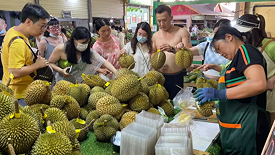
Most viewed articles


Durian, Southeast Asia's "King of Fruits," is booming in China, where it has already become the country's top fruit import item in terms of volume and value.
The upsurge is being accelerated by the new Regional Comprehensive Economic Partnership (RCEP), which has made it easier for China to import fresh fruits from Southeast Asian nations. It is also becoming a test case on how to include the country in a mega free-trade framework.
RCEP, which took effect in January, is now the world's largest trade bloc, accounting for 30% of the world's GDP. China belongs to the framework, along with 10 Southeast Asian states, Japan, South Korea, Australia and New Zealand.
The city of Xishuangbanna in China's Yunnan province is now known to have the largest concentration of durian from Southeast Asia. Located near the Southeast Asian border, the wholesale fruit and vegetable market is crowded with middlemen and tourists, and a wide variety of durian is brought in overland from all over the region.
According to a shopkeeper at a durian store, the market sells one ton of durian every day during the peak tourist season, and although costs have been reduced since the RCEP took effect, prices are actually on the rise due to China's increasing demand.
In 2021, fresh durian imports rose 42.7% year-on-year to 821,600 tons, and import value rose 82.4% to $4.205 billion, both tops in the fruit category, according to Chinese customs statistics. Imports grew almost four times as much as in 2017, with the trend appearing to be accelerating further this year.
Its "creamy taste" and high nutritional value seem to appeal to Chinese tastes. Despite the high price of more than $7 a piece, durian is stacked prominently in China's supermarkets, and a number of unique Chinese menu items have been created -- including durian cake, durian milk crepes, durian pizza and durian hot pot. All of them have received a string of enthusiastic comments from fans on social media.
In response to growing demand from China, producing countries are rushing to expand exports. Thailand produced about 1.29 million tons in 2021, up about 30% from 2019.
"China's imports are already high, but China's per capita consumption is expected to grow further. Thai farmers are highly motivated to expand production," an official at the Thai Embassy in China explained to Nikkei.
Popularity is soaring in China for a high-end Malaysian product called "Musang King" also dubbed the "Hermes of durian" in China. Although production is expected to decline this year due to heavy rains, the Malaysian government is waving the flag for export growth as plantations continue to expand, driven by large-scale corporate investment. Vietnam and Laos are also seeing a wave of investment, including Chinese money.
For these Southeast Asian countries, China's participation in RCEP is a major tailwind for export promotion. In addition to the elimination of tariffs, the agreement stipulates that customs clearance of perishable goods will basically be completed in less than six hours. This will significantly reduce costs and provide a great advantage for durian, for which freshness is critical.
On the other hand, the durian boom also sheds light on the challenges of forming a large-scale free-trade zone with China.
One is the disruption that too large a market can cause. Malaysia, for example, is rapidly developing durian plantations in its tropical rainforests, which experts say could cause environmental problems. No one knows how long the durian mania in China will last, even if output capacity is rapidly expanded for exports to the country.
There is also the risk of accelerating the economy's excessive dependence on China.
It takes more than five years for durian trees to mature and produce shippable fruit. If China stops imports after production has been ramped up to a large scale, farmers will suffer tremendous losses. In fact, China banned the import of Taiwanese pineapples last March. This was seen as a response to the Tsai Ing-wen administration, which has been critical of China. China has also halted imports of Philippine bananas due to territorial disputes in the South China Sea.
Thailand and Malaysia have no serious diplomatic or security problems with China at present. However, as the U.S.-China confrontation deepens, no one knows when tensions in Asia will escalate in the future. If economic dependence on China increases, they may be forced into a weak position in their future relationship with China.
In addition, Southeast Asian countries exporting to China need to take into consideration its vigorous research and production capabilities.
"The climate of Hainan Island is different from that of Southeast Asia, and large-scale cultivation of durian is not easy," said the president of a company investing in durian cultivation on the island province. "Even so, I think we will be able to produce first-stage products for commercialization in two years' time." The company aims to produce the popular "Musang King."
China has tried many times to produce high-end durian in places like Yunnan, Guangxi, and Hainan provinces. Although the high latitude, frequent typhoons and other climatic conditions have so far prevented commercialization, the growing demand in the Chinese market has pushed more companies to consider investment in durian production.
What would happen if China were to succeed in producing durian domestically? Like the Japanese luxury grape dubbed "Shine Muscat," Durian production might spread in China before we know it, and we may see the day when a large portion of the market is dominated by Chinese durian.
Theoretically it is desirable for a country with a huge market to join a free-trade zone such as the RCEP. But the problem is that China has different values and rules than capitalist nations.
China now hopes to join the Comprehensive and Progressive Agreement for Trans-Pacific Partnership (formerly known as the TPP) following the RCEP, and there are divergent positions among its members. China's durian craze is a reminder that a firm stance is needed to promote free trade.
Source: Nikkei Asia
- Viet Nam updates preparations for negotiations to join Information Technology Agreement expansion
- How digital payments are reshaping a fast-growing digital banking market
- Green production zones to boost standing of Vietnamese farm products
- IMF to closely monitor China’s economic growth amid trade tensions
- Export growth key to Viet Nam’s double-digit economic expansion