


Most viewed articles


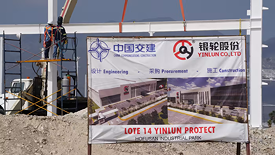
A towering red and silver gate marks the entrance to Hofusan Industrial Park, located in the middle of the desert in the Mexican state of Nuevo Leon about a two-and-a-half-hour drive from the U.S. border. Construction is in full swing at the sprawling site as trucks and cranes whiz around.
The estimated $1.2 billion project broke ground in 2017, a joint effort among Chinese companies Holley Group and Futong Group along with their Mexican partner. Twenty Chinese businesses intend to establish operations there, 10 of which have begun production on site. The project also will include restaurants, hotels and housing.
The site is not alone. Chinese direct investment in Mexico reached a record high in 2021, as more manufacturers set up shop across the border from the U.S. to circumvent tariffs imposed under the Trump administration.
Companies based in mainland China and Hong Kong invested $606.3 million in Mexico during 2021, up 76% from the year before and the highest figure since tracking began in 1999, the Mexican Secretariat of Economy reports. This made China the ninth-largest investor in Mexico, just behind South Korea.
Much of this money targets northern regions near the U.S. border. Eighteen deals were announced in Nuevo Leon last year, compared with seven in 2020 and just one or two a year between 2015 and 2018, the state government says.
Mexico has drawn investment from 1,289 Chinese companies as of 2022. China has become Mexico's second-largest import partner after the U.S., according to the Secretariat of the Economy.
The value of exports from China to Mexico was $101 billion in 2021, up 50% from five years ago and approaching half of what the U.S. exports to Mexico. The value of exports from Mexico to the U.S. totaled $398.9 billion, up 30% from five years ago, though the extent to which Chinese firms contributed is unknown.
The trend stems from the U.S.-China trade war. Then-President Donald Trump's administration imposed additional tariffs of up to 25% on a wide variety of Chinese goods beginning in July 2018. China retaliated by raising tariffs on American goods more than five times to an average of 19.3%, according to the U.S.-based Peterson Institute for International Economics.
Many of the Chinese companies investing in Mexico are appliance and furniture makers. The U.S. in 2018 slapped an additional 10% tariff on $200 billion worth of Chinese products -- including refrigerators, air conditioners and furniture -- and raised it to 25% in 2019.
"It was not common for us to help Chinese companies," said Hector Tijerina, executive director at Invest Monterrey, which promotes investment in Nuevo Leon. "But after the tariffs were imposed by the U.S. government to China in 2018, a lot of Chinese companies started to knock on the door."
Chinese appliance maker Hisense is investing $260 million to build a Mexican plant for exports headed to the U.S., with plans to mass-produce refrigerators there by the end of the year. Hong Kong furniture maker Man Wah Holdings is building a $300 million plant, while Zhejiang-based Kuka Furniture was reported in March to be expanding its capacity in Mexico.
"We want to avoid international trade barriers," said Zoy Home Furnishing, a sofa maker that established a new plant in Nuevo Leon this April.
Ningbo Daye Garden Industry, which counts the U.S. as a top market for its lawn mowers, said this month it will build a factory in Nuevo Leon "in response to future trade risks."
Mexico is an attractive manufacturing base for Chinese companies because of the U.S.-Mexico-Canada Agreement. The trade deal, which took effect in 2020, lets businesses in Mexico export goods to the U.S. tariff-free if they meet requirements such as using a certain percentage of parts made in North America.
"Hisense Monterrey is, technically speaking, a Mexican legal entity, and it has all the benefits under the free trade agreement," said Samuel Pena, vice president at Hisense's Mexico unit.
Labor costs are another factor. The U.S. federal minimum wage is $7.25 an hour, and many states have higher floors. In contrast, the general minimum wage in Mexico is around 170 pesos ($8.55) per day, or around 260 pesos closer to the border.
More Chinese companies are expanding abroad as wages rise at home. Nearshoring, or producing goods close to their target market, has gained popularity as well amid global supply chain disruptions due to COVID-19. Over 70 Chinese companies are considering their first investments in Monterrey, more than from any other country except the U.S., according to Invest Monterrey.
Mexico traditionally has prioritized ties with the U.S., its largest trade partner. But current President Andres Manuel Lopez Obrador stresses Mexico's sovereignty and has not cooperated with Washington on sanctions against Russia or tensions with China, making Mexico a friendlier environment for Chinese businesses.
Lopez Obrador takes a more protectionist approach regarding natural resources, such as with a law enacted in April that nationalizes lithium mining. But this poses relatively little risks to manufacturers, which make up the bulk of Chinese businesses investing in Mexico.
U.S. President Joe Biden is considering lowering the Trump-era tariffs on China in response to inflation. His administration has already waived the duties on certain products through the end of the year to ease pressure on businesses. But Washington and Beijing also face growing tensions over U.S. House Speaker Nancy Pelosi's recent trip to Taiwan.
Source: Nikkei Asia
- Viet Nam updates preparations for negotiations to join Information Technology Agreement expansion
- How digital payments are reshaping a fast-growing digital banking market
- Green production zones to boost standing of Vietnamese farm products
- IMF to closely monitor China’s economic growth amid trade tensions
- Export growth key to Viet Nam’s double-digit economic expansion