


Global Trade Disruptions Are About to Get Worse
26/02/2022 83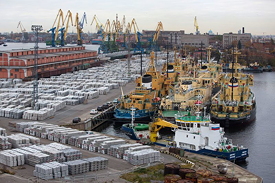
Most viewed articles


Disruptions in global trade are about to go from bad to worse.
With Russia’s invasion of Ukraine early Thursday, energy costs are soaring, stocks are plunging, Western sanctions are being sharpened, and central bankers already worried about inflation face additional drags from weaker consumer confidence and bigger potential shocks to fragile European economies.
“This will not be good for energy prices, production, or trade,” said Joseph Francois, managing director at the World Trade Institute. “Certainly we will have, and are already seeing, a spike in energy prices. This will have knock on affects on production, especially in Europe, which will dent the recovery of trade from the Covid recession.”
Russia is the world’s 16th-largest goods exporter, with petroleum, coal and gas being the biggest categories. Ukraine ranks 48th, led by shipments of grain and iron ore, according to 2020 data from the World Trade Organization.
“Undermining the rule of law and increased risk always means increased uncertainty and costs for firms operating in trade,” says Hanna Norberg, founder of TradeEconomista. “Hopefully though, the rest of the world will come together and show a unified front in terms of hard-hitting sanctions towards Russia that will work as a deterrent from further escalation and humanitarian as well as economic losses.”
For global supply chains, “a kinetic conflict in Ukraine could generate a wide range of challenges,” Chris Rogers, an economist in the U.K. with Flexport, says in a report this week. The risks extend beyond higher energy costs to include disrupted air space in the region, higher rates for shipping insurance and cyber attacks, he says.
In the immediate vicinity, there are already shipping disruptions. The editor of Lloyd’s List tweeted that vessel traffic in and out of the Sea of Asov looks to be affected by the conflict.
Peter Sand, chief analyst with Xeneta, said Russian ports on the Black Sea account for 15% of container imports and exports, its Baltic ports account for close to 50% and its far eastern ports – which are the least likely to get impacted — account for 35%.
“The important thing for all in shipping is to stay clear of breaching sanctions,” Sand said. “This goes for operators, owners and shippers.”
While the full impact of western trade sanctions remains to be seen, they're likely to have “less bite than a decade ago,” according to University of St. Gallen professor Simon Evenett. Over the past 10 years the percentage of Russia imports sourced from the European Union has fallen to 34.2% from 38.3%, while the share of Russian imports sourced from China has risen to 21.4% from 15.7%, he said.
David Henig, a director at the European Centre for International Political Economy, said other effects could be far-reaching.
“I suspect though that this will encourage some of the trends we already see, such as supply-chain resilience, and further fragmentation of rules away from WTO and towards EU and U.S. in particular strengthening their own versions of rules," Henig said.
Source: Bloomberg
- Viet Nam updates preparations for negotiations to join Information Technology Agreement expansion
- How digital payments are reshaping a fast-growing digital banking market
- Green production zones to boost standing of Vietnamese farm products
- IMF to closely monitor China’s economic growth amid trade tensions
- Export growth key to Viet Nam’s double-digit economic expansion