


Will Korea-Japan trade row enter new phase?
04/09/2020 39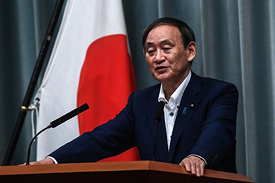
Tin đọc nhiều


Following Japanese Prime Minister Shinzo Abe's resignation, attention is being paid to the future of a trade dispute between South Korea and Japan, which has lasted since last year.
Analysts and researchers said Monday two country's trade relations will be reshaped depending on who succeeds Abe, but echoed that a drastic change over the short term is unlikely, given the conservative swing of Japan's ruling Liberal Democratic Party (LDP) and Korea's firm stance regarding history issues with Japan.
According to Japanese media reports, three men are being mentioned as major contenders to succeed Abe as leader of the LDP and therefore prime minister ― Chief Cabinet Secretary Yoshihide Suga, former Defense Minister Shigeru Ishiba and LDP policy chief Fumio Kishida.
Of them, Suga is emerging as the top pick. Described as Abe's "right-hand man," the 71-year-old has secured the backing of influential members in the party upon announcing his candidacy to LDP Secretary-General Toshihiro Nikai, Friday.
Regarding his diplomatic stance toward Korea, experts have contradicting views.
"The chief cabinet secretary is the Japanese government's top spokesperson and leads the management of the Cabinet. Given this, it can be assumed that Suga has the same views as Abe, thus there will likely be no drastic changes in the current trade relations between Korea and Japan," Kim Gyu-pan, a researcher at the Korea Institute of Economic Policy, told The Korea Times.
In August last year, Japan removed Korea from its whitelist, a list of preferred trade partners. Prior to this, Tokyo placed export restrictions on three materials ― photoresist, etching gas and fluorinated polyimide ― needed by semiconductor manufacturers here. This was interpreted as politically motivated retaliation to Korea's Supreme Court ruling that ordered Japanese firms to compensate surviving Korean victims forced to work for them before and after World War II.
Following these trade restrictions, Korea filed complaints with the World Trade Organization, which has set up a panel to look into them after the two countries showed little progress in addressing the dispute in talks.
"On the other hand, there are views that Suga is a pro-Korea and pro―China politician." Kim said. This view is convincing because Suga is backed by LDP Secretary-General Nikai, who is also known to have a dovish approach to Korea and China and is one of the most influential members in the party."
Experts said the remaining contenders are also anticipated to take similar path set by Abe in terms of diplomacy. Former Defense Minister Ishiba is an ardent critic of Abe, but is anticipated to take a hawkish approach given LDP's conservative swing. LDP policy chief Kishida is a former foreign minister under Abe and is anticipated to enhance Abe's hardline approach in addressing the Korea-Japan relations.
"Unless Kishida becomes prime minister, there will be no extreme situations such as the trade restrictions last year," Kim said.
Cho Gyeong-lyeob, the economic research director at the Korea Economic Research Institute, also predicted there will be no drastic changes in the two country's trade relations in the short term.
"It is difficult to undo a diplomatic move done in the past with a simple rapprochement gesture," Cho said. "With both countries sticking to their stance on the trade dispute, while using it as a tool for domestic politics, it is hard to expect a breakthrough in the stalemate," Cho said.
Like Japan, Korea is sticking to its initial hardline approach, as well as employing a pack of policies on growing the country's component and material industries to lower companies' reliance on Japanese imports and prevent domestic businesses from being swayed by Japan's trade restrictions.
Though analysts and researchers mostly agree with growing the country's industrial competitiveness, questions are also lingering over the feasibility of abandoning the country's supply chain closely related with companies' Japanese counterparts.
"Abe's resignation comes as a transition point providing a chance for both countries to start talks addressing the trade dispute," Cho said. "If they fail to seize this opportunity, any improvement in bilateral relations seems unlikely and more damage will be dealt to both countries' industries."
Source: Korea Times
- Intensifying enforcement of the Viet Nam - Israel Free Trade Agreement
- High-tech manufacturing creates key driver of Viet Nam's growth
- EU car industry clashes over strategy to fight Chinese competitors
- Asia-Pacific renewable investment outpaces procurement efficiency
- New carbon market boosts pioneering steel firms