


Most viewed articles


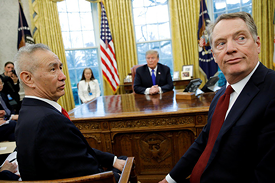
As Chinese Vice-Premier Liu He and his trade team fly off to Washington this week for round 13 of their negotiations to settle American President Donald Trump’s tariff-obsessed trade war, an audit of progress is probably in order.
The first, and easiest, prediction must be that no breakthroughs can be expected any time soon. Fifteen months after hostilities were launched, Trump’s silly tweet that “trade wars are good, and easy to win” must jar with all parties.Probably most significant is that, just as Hong Kong’s meltdown is about much more than an extradition bill, so the war launched by Trump is about much more than tariffs, about more, even, than trade. It is about the nature of United States’ political and economic engagement with the global economy.
It is about the future shape of global technology development. And, depending on how these evolve, it is about how China develops both in its own right, and in the terms of its engagement with the global economy. Trump has opened a Pandora’s box and few will emerge unharmed.
The particular tariff war that Liu’s negotiating team will be focusing on in Washington has been good for no one. In all likelihood, when a settlement is finally reached, it will be sold to US voters as a win and may be swallowed as such by many US communities.
But, in reality, it is likely to prove a painful and pointless distraction, forcing dislocation and costly restructuring of many complex global supply chains, and delivering few of the intended benefits to the US economy, to its companies and its workforce, harming US competitiveness and its reputation as a reliable and trustworthy trade or investment partner.
Taking any one of the declared aims, the numbers so far ring hollow. First, the aim to reduce China’s unacceptably high bilateral trade surplus has failed. The US trade deficit with China has barely budged.
Despite tariffs now amounting to 25 per cent for a large proportion of Chinese exports to the US, imports from China are down just 12.3 per cent in the first seven months of the year, while US exports are down 18.2 per cent, according to US government data. As a result, the China trade deficit has remained stubbornly high – around US$32 billion in August.
The plan to use the tariff war to Make America Great Again has also proven barren. The US manufacturing sector continues to steadily decline as a proportion of the total US economy. It is producing fewer new jobs than expected, with even fewer delivering improved productivity, higher salaries or more high-value-adding opportunities.Most US business organisations say there have been some companies shifting manufacturing out of China, but it seems very few of these have brought production back to the US. Instead, it has triggered some trade diversion across Asia, to Mexico and to the European Union.It seems the biggest single beneficiary of diversion away from China has been Vietnam. The US Census Bureau says trade diversion to Vietnam has lifted its exports to the US by 40 per cent in the first quarter of this year, with South Korean exports up 18.4 per cent, France up 16.5 per cent and India, 15 per cent.
Meanwhile, last week’s data from the Institute of Supply Management points to the US slipping dangerously close to recession, with average tariffs on China imports up from an average 3 per cent two years ago, to over 26 per cent today.
As Peter Boockvar, chief investment officer of Bleakley Advisory Group, noted in the Financial Times: “We have now tariffed our way into a manufacturing recession in the US and globally … using tariffs as the tool to push back against China was a really dumb idea and history will not look kind upon the strategy.”
Progress towards Making America Great Again has been invisibly slow – too slow to lift Trump’s prospects into the 2020 presidential election.
As for China feeling pain, Nick Lardy at the Washington-based Peterson Institute notes that while “maybe a few dozen” US companies have shifted manufacturing away from China, overall foreign investment in China remains strong, at around US$140 billion last year, with around 20,000 new foreign firms setting up business.
He estimates job losses in China due to the trade war of around 5 million – but in the context of a non-farming workforce of 570 million workers, he suggests this has had little impact on employment overall, in particular because of efforts to build the country’s services economy.
At the same time, the combination of tariff and technology wars has prompted Beijing’s leadership to double down on policies to reduce reliance on exports, shorten and domesticate supply chains, and boost self-reliance in all strategically sensitive technologies.
Trump’s conviction that bilateral trade deals are superior to multilateralism has also had questionable consequences. After backing out of the Trans-Pacific Partnership within days of arriving in office, and declaring a preference to negotiate bilateral trade deals, his trade team have focused mainly on two deals: the US-Mexico-Canada deal to supersede the North American Free Trade Agreement, commonly known as Nafta, and the US-Japan bilateral agreement. Neither has gone well.The successor to Nafta is still stuck in Congress awaiting ratification (and, with an impeachment investigation, is not expected to move anywhere fast). And the US-Japan trade pact, signed by Trump and Japanese Prime Minister Shinzo Abe just a couple of weeks ago, has done little more than restore some benefits to US companies that were thrown away when the US pulled out of the Trans-Pacific Partnership.Critically, it fails to address the pivotal car and car parts trade, which generate 38 per cent of Japan’s exports to the US.
It is tedious to reiterate the obvious, but a tariff war could never be an effective means of addressing the widely acknowledged challenges of doing business in China – from poor intellectual property protection and claims of forced technology transfer, to barriers to level-playing-field access to business in many sectors of the economy.
Progress on these challenges is steady but slow, and is being addressed more significantly by China’s other key trade partners in Japan, South Korea and the EU. These challenges will almost certainly be tackled multilaterally, and will be focused on the reform of China’s increasingly significant domestic economy rather than on border tariffs.
Trump’s melodramatic bluster may appeal to voters at home, where being tough on China plays marvellously, but it has produced more heat than light. Expect little of substance from Liu’s Washington visit.
Source: South China Morning Post