

Most viewed articles


President Donald Trump wants a trade deal with the United Kingdom. Getting one will be exceedingly difficult.
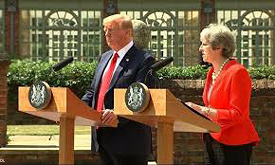
A trade accord with the United States has been touted as a potential benefit of Britain leaving the European Union. Trump and Prime Minister Theresa May both emphasized the promise of an agreement during a joint press conference on Tuesday.
But Britain can't open negotiations with potential partners until it leaves the European Union, and the country's plans for Brexit are in tatters. May is about to stand down and what happens next is anyone's guess.
Once formal discussions on a US-UK trade deal can start, they're likely to last years and could be doomed by a thorny set of political issues.
"Under the current state of play, there really isn't much investment in this at all," said Marc Busch, a professor of international business diplomacy at Georgetown University.
Big relationship, big hurdles
The European Union is Britain's largest economic partner, accounting for 49.4% of its trade. The United States ranks second, with 14.7% of total UK trade in goods and services.
Trade between the two countries topped $262 billion in 2018, according to US data. US exports of goods and services totaled $141 billion, producing a modest surplus of $20 billion. Investments total about $1 trillion, and 1 million people in each country are employed by companies from the other.
May said that she and Trump had "positive discussions" about an ambitious trade agreement. Trump added that the deal would be "phenomenal," leading to trade that would be "two and even three times of what we're doing right now."
Yet many of the demands made by the Trump administration appear to be non-starters in Britain. Trump said that all parts of the economy will be "on the table" during negotiations.
That includes contentious sectors like agriculture. The Trump administration has said that it wants to secure "comprehensive access" for agricultural goods in Britain by reducing or eliminating tariffs.
Yet scrapping those barriers could open Britain's door to genetically modified crops and animal feed with antibiotics, which are banned in the European Union but common in the United States.
Such a move would be unpopular in the United Kingdom, where politicians and the media frequently raise concerns about introducing US chicken that has been washed with chlorine.
Trump also indicated that Britain's publicly funded health system, the National Health Service, could feature in the negotiations. Similar remarks over the weekend from Woody Johnson, the US ambassador to Britain, sparked an immediate political backlash.
David Henig, director of the UK Trade Policy Project and a former UK trade official, said the idea that "American capitalists want to dismantle the NHS" won't be well received.
Liam Fox, Britain's international trade secretary and a supporter of Brexit, told the BBC Tuesday that "regulation of public services is a clear exemption when it comes to trade agreements."
Europe or the US?
Britain currently does business with the world on terms negotiated by the European Union, which handles trading relationships with third countries for its members.
Leaving the bloc -— itself far from certain because of the political crisis in the United Kingdom -— would allow the country to negotiate its own trade deals.
But straying too far from the European Union would have consequences.
Negotiating partners including the United States will seek to extract concessions from Britain that may include changes to safety and environmental standards that are common across the European Union.
That would push Britain further away from its largest trading partner and make it harder to avoid border checks between Ireland and Northern Ireland, which is part of the United Kingdom.
Source: CNN