

Most viewed articles


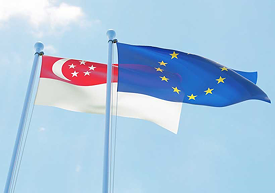
Trade Committee MEPs agreed on Thursday to the EU-Singapore free trade agreement, a stepping stone to cooperation between the EU and Southeast Asia.
The agreement will remove virtually all tariffs between the two parties at the latest in five years. It will liberalise trade in services, protect unique European products, and opens up the Singaporean procurement market. The agreement includes strengthened labour rights and environmental protection.
Trade Committee MEPs emphasised that since this is the first bilateral trade agreement between the EU and a member of the Association of Southeast Asian Nations (ASEAN), the deal can serve as a stepping stone to future free trade deals between the two regions, at a time when the EU can no longer rely on the US as a trading partner.
The main elements of the trade deal are the following:
removal of many non-tariff barriers: Singapore will recognise the EU safety tests for cars and certain electronics, including household devices or adapters. It will also accept EU labels and markings for clothing and textiles;
Geographical indications (GIs): Singapore will protect around 190 EU GIs to the benefit of EU food and drink producers, including those of Jerez wine, Comté cheese, Nürnberger Bratwurst and aceto balsamico di Modena;
public procurement: more access to supply goods and services to the Singapore government;
services: liberalisation of financial, postal, telecommunications, transport and information technology services. Mutual recognition of the qualifications of architects, lawyers and engineers;
sustainable development: Singapore will implement core labour rights conventions, the Paris Agreement on climate change, and the sustainable management of forests and fisheries.
The trade committee gave its consent to the agreement by 25 votes to 11, with one abstention. The accompanying resolution, laying out the recommendations of the committee, was adopted by 25 votes to 10, with two abstentions.
Settling disputes between companies and state
The committee also agreed to the Investment Protection Agreement which, once ratified by all EU member states, will replace the existing bilateral agreements between Singapore and 13 EU member states with a more modern approach to dispute settlement. Trade Committee MEPs gave their consent by 26 votes to 11. The resolution was adopted by 25 votes to 12.
On Tuesday, the Foreign Affairs Committee voted to give its consent to the Partnership and Cooperation Agreement between the EU and Singapore, which extends cooperation beyond the field of trade.
Quote
“Today’s vote shows support for a progressive EU trade and investment policy. The trade agreement will not only enhance the EU’s access to the Singapore market, but even more to the growing ASEAN region, while ensuring workers and the environment are well protected. The investment protection agreement incorporates the EU’s reformed approach, and will replace the existing deals between Singapore and 13 Member States that include the toxic investor-state dispute settlement,” said David Martin (S&D, UK), the rapporteur on the agreements on the free trade and the investment protection deals.
Next steps
Parliament is set to vote on the trade deal and the investment protection agreement on 12 February in Strasbourg. Once Council concludes the trade agreement, it can enter into force. For the investment protection agreement to enter into force, the member states first need to ratify it.
Background
Singapore is by far the EU’s largest partner in the region, accounting for almost a third of EU-ASEAN trade in goods and services, and roughly two-thirds of investment between the two regions. Over 10,000 European companies have their regional offices in Singapore.
The Swedish Green Party has just formed a government with the Social Democrats blocking right-wing extremists from power. This will be their second time in government after having been elected in 2014. It will include 5 Green Ministers.
Isabella Lövin will be Minister for the Environment and Climate, as well as Deputy Prime Minister. Per Bolund stays at the Ministry of Finance and continues as Deputy Finance Minister. He will also take over the responsibility for housing issues. Peter Eriksson will act as Minister for Development Cooperation at the Ministry of Foreign Affairs. Åsa Lindhagen will be the Minister for Gender Equality at the Ministry of Labour and will also be responsible for the work against discrimination and segregation. Amanda Lind will become Minister of Culture and Democracy at the Ministry of Culture. She is also responsible for youth and sports issues.
The Swedish Greens say this will allow them build upon the foundations they laid in the last 4 years and “continue to take responsibility for the climate, gender equality and compassion.” They have announced that priorties will include investing in high-speed-trains that connect to the rest of Europe and sweeping new reforms to make Sweden the first fossil free welfare country.
Four months ahead of the European elections, the European Parliament has unveiled a new website detailing how to vote in each member state or from abroad.
The website is designed to help people find all relevant information they need in one place. This is the first time that the Parliament has offered such a tool to enable everyone to make their vote count in the European elections.
Step-by-step to cast your vote
National voting rules for each country are explained in a Q&A format, including information on voting day, voting age, registration deadlines, documents needed to register to vote as well as thresholds for political parties or total number of MEPs to be elected per country and links to the websites of national electoral authorities.
As this information is country-specific, the website provides answers on each EU country in the official language(s) of that country and in English.
Voting from abroad
The website offers information on how to vote from abroad (whether from another EU country or from a third country) or by proxy. This might be particularly relevant, for instance, for some 3 million EU citizens residing in the UK.
The website also contains:
• a ‘question and answer’ section on the European Parliament, the lead candidates and what happens after the elections,
• information on how citizens can get involved in raising awareness of the elections themselves,
• a section with election-related news from Parliament’s main website,
• a link to an election results page,
• links to European Parliament’s political groups and European political parties.
MEPs strongly condemn the aggressive actions of Russia, China, Iran and North Korea, which seek to undermine the normative foundations of European democracies.
In a resolution adopted by the Foreign Affairs Committee on Tuesday, MEPs take stock of the EU’s latest efforts to counteract hostile propaganda by third parties and propose new actions.
Robust response needed
The Committee wants the EU and its member states to adopt a firm response to tackling the increasingly sophisticated tools used by opinion formers and state-controlled institutions to spread disinformation, for example via private messaging apps, search engine optimisation, artificial intelligence and on-line news portals and TV-stations.
MEPs strongly condemn the increasingly aggressive actions of Russia, China, Iran and North Korea in this context, which seek to undermine the “normative foundations and principles of European democracies and sovereignty of all Eastern Partnership countries”, as well as influence political elections and support extremist movements, according to the text.
The resolution also recommends:
• All EU countries that continue to deny the existence of disinformation and hostile propaganda, as well as its impact on public opinion, should recognise them, evaluate the situation within their territory and take proactive measures in order to counteract and debunk it,
• The EU and its member states should consider developing a legal framework both at EU and international level for tackling hybrid threats, also covering targeted sanctions against those responsible for orchestrating and implementing disinformation campaigns,
• the actions of social media companies, messenger services and search engine providers should be regulated to ensure their full transparency,
• Technology companies should invest more in tools identifying propaganda and ensure better identity checks of platform users, in order to eliminate botnets as well as reducing financial incentives for those who profit from disinformation,
• outsourcing propaganda and use of multiplying tools by hostile third parties should be investigated in more depth,
• publicly naming the perpetrators and the goals they seek to achieve, and also publicising all debunked cases of hostile propaganda accompanied with a detailed factsheet,
• urgently turning the EU’s East StratCom Task Force into a fully-fledged unit or even a bigger structure within the European External Action Service (EEAS), as well as providing all three EEAS Strategic Communication Task Forces with adequate financial and personnel resources, and
• assisting accession countries and partners in the EU neighbourhood in their efforts to counteract hostile propaganda and disinformation activities.
Quote
“The European Parliament once more encourages the EU institutions to be more active in countering hostile disinformation. We have also invited all Member States to evaluate the situation within their territories. This report recalls the need to prioritize this issue at EU level. It proposes a number of recommendations on how to change the approach of our institutions, improve coordination or address the role of artificial intelligence and new technologies in advancing this threat”: said EP rapporteur Anna Elżbieta Fotyga (ECR, PL).
Next steps
The resolution was adopted by 49 votes in favour, 7 against and 2 abstentions. It will be tabled for a plenary vote during the February Strasbourg session.
Background
The resolution takes stock of the follow-up taken by the European External Action Service two years after the last EP report on EU strategic communication to counteract propaganda, which was adopted on 23 November 2016.
Source: Modern Diplomacy