

Most viewed articles


European trade chief Cecilia Malmström has been welcomed to the capital, as international trade and diplomacy circles look to mark the beginning of a free trading relationship between New Zealand and the European Union (EU).
Offering her congratulations to Prime Minister Jacinda Ardern - in hospital awaiting the birth of her first child - Malmström said she and Trade Minister David Parker were pleased to give birth to the launch of free trade negotiations.
Malmström is one of the most powerful leaders in the European Commission - the body which negotiates trade on behalf of the EU. Her visit marks the formal launch of negotiations, with trade negotiation teams from both sides set to start their first round of bargaining in Brussels over July 16-20.
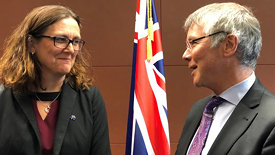
European Union Trade Commissioner Cecilia Malmström is welcomed to Parliament by Trade Minister David Parker, to formally launch free trade negotiations between New Zealand and the EU.
At a press conference following their meeting, Malmström and Parker said the FTA represented a "very special opportunity".
"Today is an important milestone in EU- New Zealand relations. Together, we can conclude a win-win agreement that offers benefits to business and citizens alike," said Malmström.
Your key to unlocking NZ politics: Sign up for our newsletter
"This agreement is an excellent opportunity to set ambitious common rules and shape globalisation, making trade easier while safeguarding sustainable development. We can lead by example."
The deal was hoped to stand up as a counter and example of what a "rules based" progressive trade agreement could look like, particularly in the face of a push towards protectionism from some countries, including the United States.
Agriculture had always been a difficult issue at the end of most negotiations but a compromise had always been found, Malmström assured.
Meanwhile, New Zealand was expected to be more closely aligned on the issue of medicine patents with Europe, than it was with the United States during negotiations for the Trans-Pacific Partnership Agreement, but the issue was likely to be another sticking point at negotiations regardless.
Both sides said it would be carefully talked about, but it was a matter of finding a balance between protecting the intellectual property of drug companies and controlling the cost of medicines.
Parker said the agreement would be held as a guiding example for a new type of trade deal.
"We can not only do good for ourselves in this trade agreement but we can actually set out rules for how trading agreements should look for the betterment of the world."
The Government recently launched its "Trade for All" trading agenda, which calls for a "progressive and inclusive" approach to negotiating trade deals.
It sits in line with similar EU policy that seeks to create a new kind of trade deal that takes into account environmental sustainability, inclusiveness for minority and indigenous groups and the protection of human rights.
The Government and the EU have already ruled out the inclusion of any investor state dispute clauses in this deal - a controversial mechanism that allows companies to sue Governments over policy changes that may leave them worse off.
While it's widely featured in agreements, ISDS clauses are rarely used given there's a high-threshold to pass before it can be triggered.
New Zealand and the EU are already close trading partners with about $20 billion in two-way trade annually. That figure dropped to around $16b with the United Kingdom (UK) removed from the equation, as it would be at the conclusion of negotiations deal.
Early estimates suggest an EU FTA could add another $1b -$2b to New Zealand's annual GDP over time, with a 10 to 22 per cent increase in trade volumes.
The EU is the world's biggest market of 500 million, and the removal of tariffs to goods at the border would be a huge economic boon to small and medium-sized exporting businesses, in New Zealand.
At the same time, the cost of importing European goods would be significantly reduced. Goods like wine, food, clothing, pharmaceuticals and cars are among key imports - currently valued at about $8.9b each year.
Over a two-day visit, she will hold high-level talks with Parker and Acting Prime Minister Winston Peters, and make a number of visits to businesses in Auckland, as well as hold a public forum to answer questions on the FTA.
Source: Stuff
- Trump says Viet Nam to face 20% tariff under 'great' deal
- US Forced Labour Hearings: Trump's next tariff threat looms over 60 countries, including India
- Viet Nam, France advance implementation of Comprehensive Strategic Partnership
- Business community key to Viet Nam's Net Zero journey: Deputy Prime Minister
- New push to stabilise Viet Nam property market