



Malaysia's market size
Malaysia is the 6th largest economy in ASEAN and ranks 10th among the members of the Regional Comprehensive Economic Partnership (RCEP), with total GDP reaching approximately USD 422 billion in 2024 (World Bank data, 2025).
During the 2015–2024 period, Malaysia maintained steady economic growth, with GDP rising from USD 301 billion in 2015 to USD 422 billion in 2024, equivalent to average annual growth of around 4%—an impressive result in the context of a highly volatile global economy, where average world growth during the same period was only 2.8% per year.
Like many other economies, Malaysia was negatively affected by the COVID-19 pandemic in 2020, with GDP declining by 5.5% compared with 2019. However, the economy recovered quickly and resumed growth from 2021, reaching a record-high GDP of USD 422 billion in 2024.
Figure: Malaysia’s GDP, 2015–2024
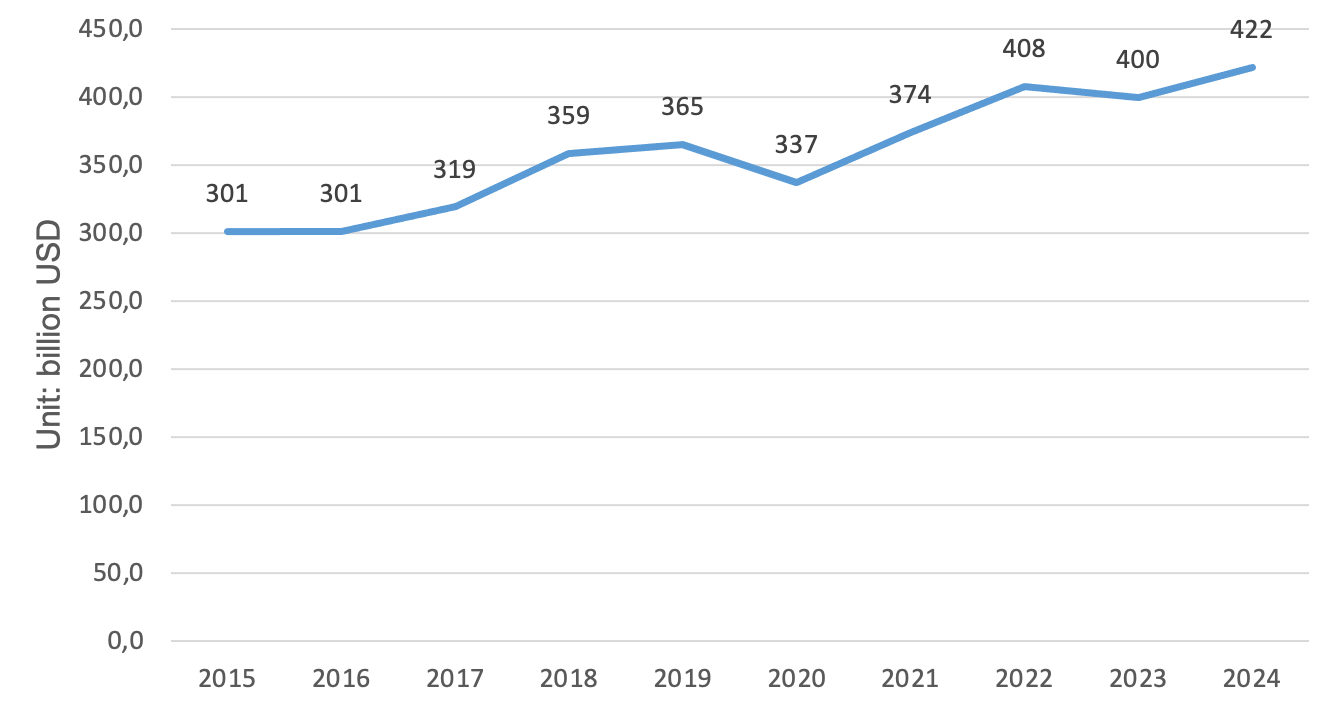
Source: World Bank, 2025
In terms of macroeconomic indicators, Malaysia’s economy is considered relatively stable. During the 2015–2024 period, Malaysia’s average inflation rate was around 1.9% per year, while the average unemployment rate was approximately 3.7% per year (World Bank, 2025).
In terms of population size, Malaysia had about 35.6 million people as of 2024, of whom more than 70% were of working age (15–64), creating a demographic dividend—an important foundation for growth and domestic consumption. Although the population is not large, Malaysia remains an attractive market thanks to its rapidly expanding middle class, high urbanization rate (79% of the population), and one of the highest living standards in Southeast Asia (GDP per capita reached USD 11,867 per person per year in 2024). These factors are opening up strong consumer potential and creating favorable conditions for exports to this market.
Source: Center for WTO and International Trade - VCCI
