



Consumer characteristics in New Zealand
The majority of New Zealanders are in the high-consumption age group (15 to 64 years old), accounting for about 64.8% of the country's population (World Bank 2023 data). New Zealand's population is mainly concentrated in the North Island (accounting for about 76.5% of the population), of which Auckland is the largest and most populous city, accounting for about 33.4% of the country's population.
Despite its very small population (only about 5.2 million people), New Zealand is among the group of high-income developed countries in the world, with a GDP per capita of about 41,725 USD (World Bank 2023 data). With this income level, New Zealand consumers have the ability to pay a lot for consumer goods.
However, the gap between rich and poor in New Zealand is relatively large, so the demand for consumer products of New Zealanders is also clearly different. Consumer products in New Zealand are very diverse, from essential products such as food, clothing, shoes... to entertainment and luxury products such as jewelry, cars of all kinds, technology products...
Main consumer products
According to OECDStat 2022 data, New Zealand consumers spend up to 26% of their total spending on housing, electricity, water, and other fuel needs. Next, New Zealanders spend 12.3% on food and beverages, 11.2% on transportation/travel... Thus, New Zealand consumers spend half of their spending on essential products/services to serve their personal needs of eating, living, and traveling.
In addition, New Zealand consumers also spend a lot on products/services for entertainment purposes, bringing many personal experiences. Specifically, people in this country spend 9% on culture, entertainment and 7.1% on restaurants, hotels...
Table 1 - Common consumer goods and services in New Zealand in 2022
|
Consumer goods/services |
Percentage in total expenditure of consumers |
|
Housing, water and electricity, natural gas, and other fuels |
26% |
|
Food and non-alcoholic beverages |
12.3% |
|
Transportation |
12.2% |
|
Culture and leisure |
9% |
|
Restaurants and hotels |
7.1% |
|
Furnishings, household equipment and everyday maintenance of the house |
5.7% |
|
Alcoholic beverages, tobacco and narcotics |
4.7% |
|
Clothing and footwears |
3.8% |
|
Health |
2.9% |
|
Communication |
1.8% |
Source: OECDStat, 2024
Consumption trends in New Zealand
New Zealand consumers have high demands for standards and quality of consumer goods, so New Zealanders' purchasing decisions are often influenced/dominated by the quality and brand of the product. New Zealand consumers have high incomes, so they are willing to pay high prices for good quality products. However, with the recession, inflation is increasing due to the impact of the COVID-19 pandemic and the Russia-Ukraine conflict... New Zealand consumers are also increasingly concerned about price when choosing to shop.
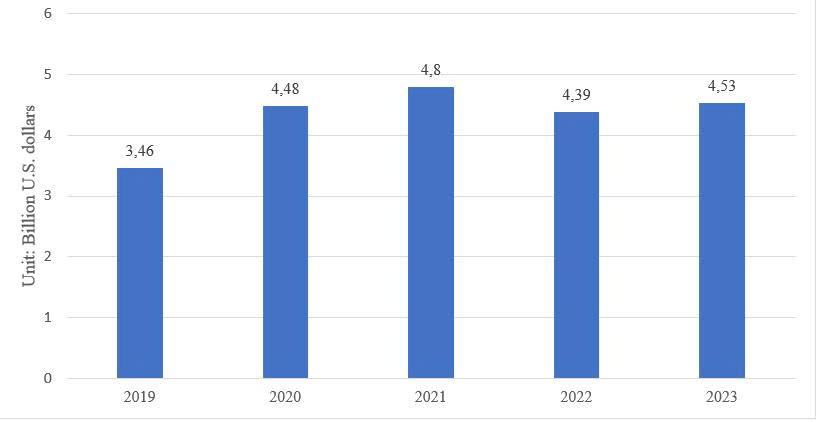
E-commerce is growing in New Zealand as people tend to switch to online shopping through online retail websites/channels such as Mighty Ape, Fishpond, Trade Me... since the outbreak of the COVID-19 pandemic. New Zealand consumers are also increasingly shopping through e-commerce sites because they can compare prices, buy products at affordable prices, and receive many incentives/discounts when purchasing. The e-commerce market revenue in New Zealand has increased significantly during the period 2019-2023, from 3.46 billion USD in 2019 to 4.53 billion USD in 2023 (Statista.com, 2024).
Figure 1 - E-commerce market revenue in New Zealand 2019-2023
Source: Statista.com, 2024
Source: Center for WTO and International Trade
