

The Viet Nam-EU Free Trade Agreement: Institutional Impacts and Policy Adjustments in Viet Nam

The EVFTA is one of the largest free trade agreements that Viet Nam has ever participated in and is expected to bring about significant institutional and policy transformations, elevating Viet Nam’s economy to a new level of development upon its official implementation.
By participating in the Viet Nam-EU Free Trade Agreement (EVFTA), Viet Nam is expected to enhance its competitiveness through economies of scale; attract increased foreign direct investment to capitalize on the benefits of the FTA; and undertake institutional and policy reforms that improve predictability and reduce risks. In addition, Viet Nam will benefit from access to high-quality production inputs and from positive competitive pressures, among other advantages. Accordingly, Viet Nam set the objective for the EVFTA to be implemented in 2018.
Similar to the Trans-Pacific Partnership (TPP), the commitments under the EVFTA are not confined to tariff elimination and trade facilitation, but extend far beyond these areas. The behind-the-border commitments encompass state governance practices, legislative processes, investor-state relations, the promotion of a level playing field among economic actors, labor relations, and other related issues.
Research findings indicate that while the direct impacts requiring amendments to domestic legislation in order to comply with the Agreement’s commitments are relatively limited, the indirect impacts on broader economic institutional reform are substantial. These impacts are particularly significant in the areas of the investment climate, state-owned enterprises, the business environment, and overall competitiveness. These challenges become more pressing given the relatively low level of readiness of both the economy and enterprises for the implementation of the Agreement.
Furthermore, under the EVFTA, commitments on customs and trade facilitation are clearly articulated in Chapter 5 and Chapter 20 - the Protocol on Customs Cooperation and Mutual Administrative Assistance. These chapters set out obligations relating to customs procedures, trade facilitation, customs assistance, and cooperation between the customs authorities of the two parties. Most of these commitments are required to be implemented immediately upon the entry into force of the Agreement. As a result, the implementation of the EVFTA will strongly encourage Viet Nam to further improve its institutional framework and policies related to customs administration.
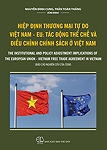
Against this background, the Central Institute for Economic Management (CIEM) has published the study “The Viet Nam-EU Free Trade Agreement: Institutional Impacts and Policy Adjustments in Viet Nam”, which aims to analyze and support Viet Nam in adjusting and reforming its institutional and policy framework across various areas, including the investment and business environment, competitiveness, and state-owned enterprise reform, among others, in the process of implementing the EVFTA.
The publication (in Vietnamese) is attached below:
 The Viet Nam-EU Free Trade Agreement: Institutional Impacts and Policy Adjustments in Viet Nam
More stories
- Handbook "Q&A About Key Considerations For Doing Business In German Market"
- Report: "Vietnam after two years of EVFTA implementation from a business perspective"
- EVFTA with Viet Nam's Trade Journal on Agricultural Products QIV/2021
- Report: One-year assessment of EVFTA implementation - Impacts on the Vietnamese economy and policy formation
- Viet Nam - EU Trade Journal QIII/2021